
Getting the dose and water right for any coffee brewing method
This article explains the coffee ratio calculator, walks through every control, shows worked examples for filter and espresso, and clears up the confusion between water poured and coffee in the cup that leaves so many people wondering why their carafe always seems short.
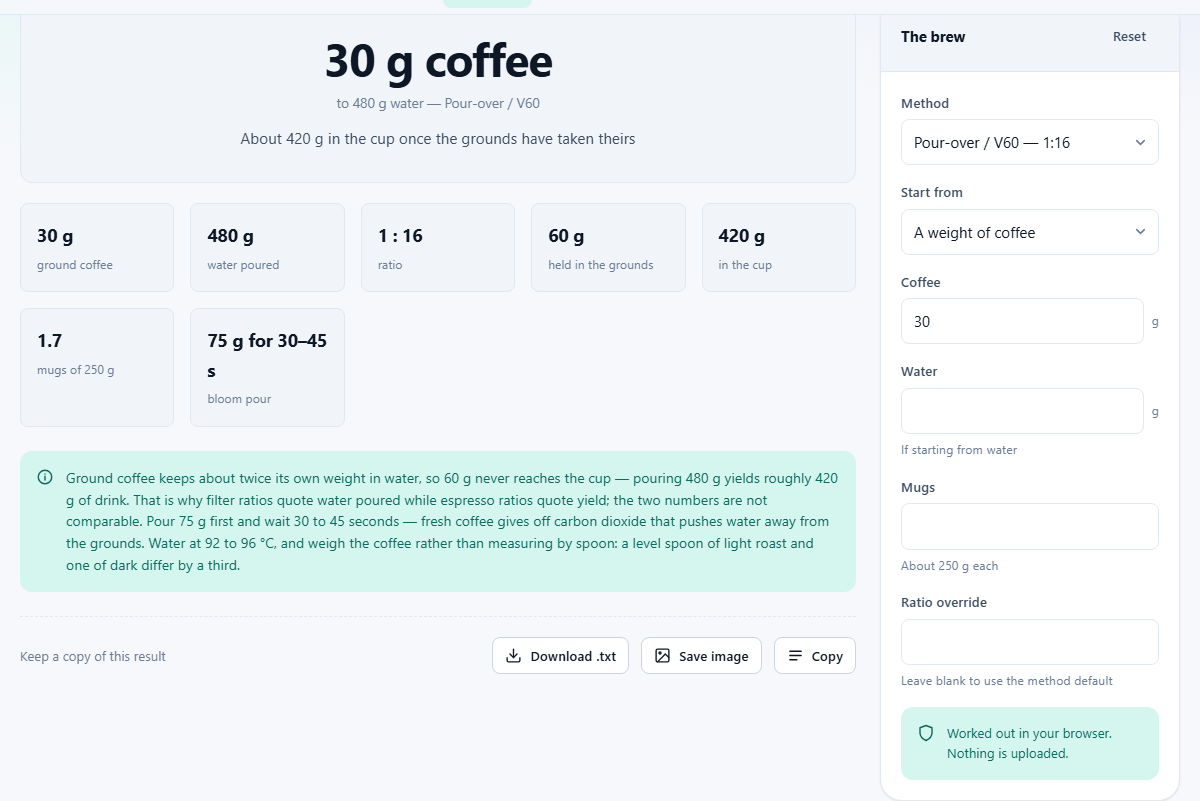
The gap between what you pour and what you drink
A common surprise for anyone who starts weighing their coffee is that a pour-over brewed with 500 grams of water does not produce 500 grams of coffee. The grounds absorb water and hold it. About two grams of water stay trapped in every gram of dry coffee, so 30 grams of grounds swallow roughly 60 grams of water and never give it back.
That gap explains why a pot always looks short. It explains why a recipe that says 500 ml of water for two mugs only fills one and a half. And it explains why filter ratios and espresso ratios cannot be compared directly, since they measure different things.
The calculator does the arithmetic for you. Give it one number you know, whether that is a weight of coffee, a weight of water, or a number of mugs, and it fills in all the rest, including the amount of liquid that will actually end up reaching your cup.
Choosing a brewing method
The first dropdown, labelled Method, sets the default ratio and the behaviour of the rest of the form. Six methods are offered.
Pour-over and V60 at 1:16 is the most common starting point for manual filter coffee. For every gram of coffee you use sixteen grams of water. It produces a clean, bright cup.
French press at 1:15 uses slightly more coffee per unit of water, which suits the longer steep time and the way a metal filter lets oils and fine particles through.
AeroPress at 1:14 is stronger again because the brew time is short and the volume is small. Many AeroPress recipes push the ratio even further, but 1:14 is a reasonable middle ground.
Batch filter at 1:17 is a touch weaker, designed for machines that brew larger volumes. The extra water compensates for the fact that a big batch cools more slowly and extracts a little more.
Espresso at 1:2 is a completely different kind of ratio. It measures dose to yield, not dose to water poured. Eighteen grams of coffee in, thirty-six grams of liquid out. The calculator knows the difference and adjusts its output accordingly.
Cold brew concentrate at 1:5 produces a strong liquid meant to be diluted before drinking. The low ratio and long steep time pull out a lot of flavour with very little acidity.
Telling the tool what you know
The dropdown labelled Start from gives you three choices: A weight of coffee, A weight of water, and A number of mugs. Pick whichever one matches the thing you already know, and the tool works out the other two.
If you start from a weight of coffee, type the grams in the Coffee field. The default is 30 grams. The tool multiplies that by the ratio to get the water, then subtracts the amount absorbed by the grounds to give the yield.
If you start from a weight of water, type the grams in the Water field. The tool divides by the ratio to get the dose, then works out the yield.
If you start from a number of mugs, type how many in the Mugs field. Each mug is treated as about 250 grams of drinkable liquid. The tool works backwards from that target to figure out how much coffee and how much water you need to reach it, accounting for absorption.
Overriding the default ratio
The Ratio override field lets you replace the built-in ratio for the chosen method. Leave it blank and the method's default is used. Type a number and that number takes over.
This is useful when a recipe you found online calls for a ratio that does not match any of the six presets. It is also useful for dialling in your own preference. If 1:16 produces a cup that tastes thin to you, try 1:15. If it tastes heavy, move towards 1:17. Small changes make a noticeable difference, and the calculator lets you see exactly how the dose and water shift with each adjustment.
For espresso the override works the same way but the numbers are much smaller. A standard espresso pull is 1:2, a ristretto is closer to 1:1.5, and a lungo might be 1:3 or beyond. Typing 1.5 in the override field while the method is set to espresso gives you the ristretto dose.
Worked example: pour-over for two people
You want two mugs of coffee using a V60. Set the Method to Pour-over and the Start from dropdown to A number of mugs. Type 2 in the Mugs field. The calculator works out that you need about 500 grams of drinkable coffee, which at a 1:16 ratio requires roughly 33 grams of coffee and about 528 grams of water.
The yield line shows that the grounds will absorb around 66 grams of water, leaving about 462 grams in the pot. That is close to two mugs but not quite two full ones, which matches the real-world experience of always seeming a little short.
If you want exactly two full mugs, nudge the number up to 2.2 or switch to Start from A weight of water and type 560. The extra water covers the absorption loss and fills both cups to the brim. This kind of back-and-forth adjustment is exactly what the calculator is for. Without it you would need to do the absorption subtraction in your head every time.
Espresso versus filter: two different conversations
The biggest source of confusion in coffee arithmetic is comparing espresso ratios with filter ratios. A filter recipe at 1:16 means one gram of coffee to sixteen grams of water poured into the brewer. An espresso recipe at 1:2 means one gram of coffee to two grams of liquid that dripped out of the machine.
These are measuring different things. The filter ratio counts water in. The espresso ratio counts liquid out. A standard espresso actually pushes far more than twice the coffee weight through the puck, but most of that water stays behind in the spent grounds and the drip tray.
The calculator handles this behind the scenes. When the method is set to espresso, the absorption step is skipped and the yield is the ratio applied directly. When any other method is chosen, the absorption step is included and the yield is lower than the water poured. Switching between the two and watching the numbers change is the fastest way to understand the difference.
Mistakes that lead to bad cups
The most common mistake is scooping instead of weighing. A level tablespoon of light-roasted beans and one of dark-roasted beans differ by roughly a third in weight because the darker roast is less dense. A kitchen scale removes that variable entirely and is the single cheapest upgrade that makes the biggest difference.
Another frequent error is using boiling water straight off the stove. Water between 92 and 96 degrees gives the best extraction. Boiling water scalds the coffee and pulls out bitter compounds that make the cup harsh. Waiting about thirty seconds after the kettle clicks is enough.
Forgetting the bloom is a subtler problem. Fresh coffee releases carbon dioxide when it first meets water, and the gas pushes liquid away from the grounds. Wetting the bed with a small amount of water and waiting 30 to 45 seconds lets the gas escape before you pour the rest. Skipping this step leads to uneven extraction and a flat-tasting cup.
One last mistake is treating the ratio as the whole recipe. The ratio sets the dose and water, but grind size, water temperature, and pour speed all change the flavour without changing any of the numbers. Two cups brewed at exactly 1:16 can taste completely different if one was ground fine and the other coarse. The calculator handles the proportion. The rest is technique.
Privacy and where the maths runs
The calculator runs entirely on your device. No dose, no ratio, and no result leaves your browser. Nothing is saved between sessions and there is no account to sign up for. Close the tab and every number you entered is gone. Whether you are a cafe owner testing recipes or a home brewer dialling in a new bag, your numbers stay on your own machine.