
Getting salt, sugar and curing salt right for brines and cures
This article explains the brine and cure calculator in full. You will learn the difference between a wet brine and an equilibrium cure, see what every control on the page does, walk through two worked examples with actual gram amounts, and understand why the nitrite calculation is handled with extra caution.
Two methods that share a name
Brining and curing both involve salt and meat, but they work in opposite directions and the consequences of mixing them up range from a ruined dinner to something genuinely unsafe.
A wet brine dissolves salt in water and soaks the meat in it. The salt moves steadily from the water into the meat for as long as the meat stays in the liquid. Leave a chicken breast in a strong brine overnight and it will be too salty to eat. The clock is running the entire time.
An equilibrium cure takes the opposite approach. You weigh out exactly the amount of salt you want in the finished product, rub it onto the meat and seal everything in a bag. Because the total salt is fixed, once it has spread evenly through the meat it stops. There is no more salt to take up. A piece of pork belly sealed with a 2% cure can sit in the fridge for two weeks and it will never be saltier than 2%.
The calculator handles both. The Method dropdown at the top of the panel is where you choose, and everything else on the page adjusts to match.
The controls for an equilibrium cure
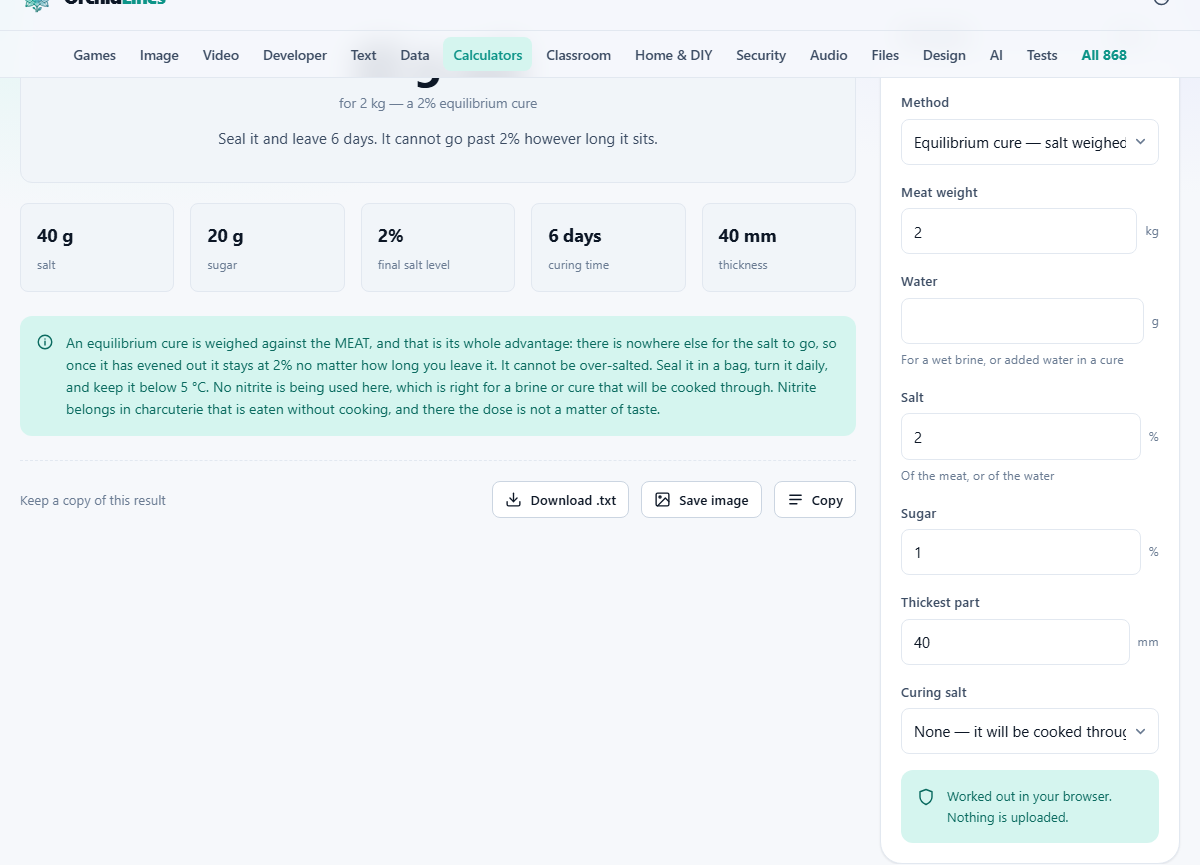
With Method set to Equilibrium cure, the panel asks for five things. Meat weight takes the weight of your piece in kilograms. Salt is the percentage of the meat weight you want as salt in the finished product. Two per cent is a solid starting point for bacon, gravlax, duck breast or any cut you plan to cure and then cook. Sugar works the same way as salt, and one per cent is a common default. It balances the flavour but plays no role in preservation.
Thickest part is measured in millimetres. Salt moves inward at roughly a centimetre a day, so the calculator uses this to estimate the curing time. A thin salmon fillet might be 20 mm at its thickest. A pork belly could be 50 mm or more. The time goes up accordingly.
Water appears below the meat weight. For an equilibrium cure, added water is usually zero unless you are making a brine-style cure in a bag with a small amount of liquid. If you leave it empty the calculator ignores it.
The controls for a wet brine
Switch Method to Wet brine and the arithmetic changes. Now the Salt percentage refers to the water, not the meat. A typical wet brine for poultry runs between five and six per cent salt by weight of the water.
Water becomes important. If you leave it blank the page defaults to using one litre per kilogram of meat, which is a reasonable starting point for most whole birds. If you know how much water your container holds, type the amount in grams for a more precise salt figure.
The Thickest part still drives the timing, but the formula is different. A wet brine at five per cent works faster than a two per cent equilibrium cure because the concentration gradient is steeper, so the estimated soak time comes out in hours rather than days. The calculator warns you that this is a deadline, not a suggestion. Leaving the meat in longer does not improve the result; it just makes it saltier.
A worked equilibrium cure: bacon
Start with a two-kilogram piece of pork belly for bacon. Set Method to Equilibrium cure, type 2 in Meat weight, leave Salt at 2% and Sugar at 1%. The belly is about 45 mm thick at its deepest, so put 45 in Thickest part.
The result says 40 g of salt and 20 g of sugar. Curing time is about 7 days. The final salt level with no added water is 2%. Rub the salt and sugar into every surface of the meat, seal it in a zip-lock bag with as much air pressed out as possible, and put it in the fridge. Turn the bag over once a day.
After seven days the salt has spread evenly through the meat. Rinse the surface, pat it dry and leave it uncovered in the fridge overnight. That dry surface is what gives bacon its browning when you cook it. Slice and fry as normal.
If life gets in the way and the belly stays in the bag for ten days instead of seven, nothing goes wrong. The salt has nowhere else to go. That safety margin is the whole point of the method.
A worked wet brine: roast chicken
Set Method to Wet brine. The chicken weighs 1.8 kg, so type 1.8 in Meat weight. You are using a pot that holds 2 litres of water, so type 2000 in Water. Leave Salt at 5% for a standard poultry brine, and Sugar at 1% for a touch of sweetness in the skin.
The calculator returns 100 g of salt and 20 g of sugar, dissolved in 2000 g of water. The chicken is roughly 120 mm through the thickest part of the breast, but the soak time estimate accounts for the brine working from both sides, so it suggests about 7.2 hours.
Dissolve the salt and sugar in the water, cool it completely, then submerge the chicken. Refrigerate it for the time shown and not much longer. When the time is up, take the chicken out, pat it thoroughly dry, and roast as usual. The skin will brown well and the breast will be noticeably juicier than an unbrined bird.
The critical difference from the equilibrium method: if you forget the chicken in the brine overnight, it will be too salty. The water keeps pushing salt into the meat for as long as they are in contact.
Curing salt and nitrite
The Curing salt dropdown at the bottom of the panel has two options: None and Curing salt #1 (sodium nitrite). For a wet brine going straight into the oven, or an equilibrium cure that will be cooked through, you want None.
Curing salt #1 is needed for products that are eaten without full cooking: bacon that is cooked but sometimes left pink in the middle, air-dried charcuterie, and cold-smoked fish. Nitrite prevents the growth of dangerous bacteria, particularly botulism, and gives cured meat its characteristic pink colour. Without it, a piece of meat held at low temperatures for days would carry real risk.
When you select Curing salt #1, the calculator shows the amount in grams and the resulting concentration in parts per million. The standard rate is 2.5 grams of curing salt #1 per kilogram of total mass, which delivers around 156 ppm of sodium nitrite. That is well within safe limits but must be weighed accurately.
This is the one number in the calculator where getting it wrong is not just a matter of taste. Curing salt #1 is toxic in large quantities. Measure it on a kitchen scale that reads to 0.1 g, never by spoon or by eye. Keep it labelled clearly and stored separately from table salt. If you are not sure whether you need it, you almost certainly do not.
Why weight matters more than volume
Every figure the calculator produces is by weight, and that is deliberate. A cup of coarse flaky salt and a cup of fine table salt contain dramatically different amounts of actual sodium chloride. The flaky salt has big air gaps between the crystals. The fine salt packs tight. The difference can be more than fifty per cent.
If a recipe or a calculator tells you a quantity of salt in grams and you scoop it with a measuring cup instead, you may be using half the salt or twice the salt the formula intended. For a wet brine that just means a bland or over-salted result. For a cure with nitrite, the error has more serious implications.
A cheap kitchen scale that reads to one gram is accurate enough for salt and sugar. For curing salt you want a scale that reads to a tenth of a gram, which is still an inexpensive piece of equipment.
Common mistakes and safety notes
The most frequent error is confusing the two methods. If you are calculating a wet brine but the dropdown is set to Equilibrium cure, the salt amount will be far too low because the percentage is being applied to the meat weight instead of the water weight.
Another common problem is not measuring the thickest part of the meat. The centre of a pork shoulder can be much thicker than it looks once you account for the bone. If the calculated time is based on 40 mm but the actual thick section is 70 mm, the salt will not have reached the middle.
Temperature matters too, even though the calculator does not ask for it. Everything should be refrigerated below 5 degrees Celsius for the entire curing period. Salt slows bacterial growth but does not stop it at room temperature, and leaving a cure on the kitchen counter is not safe.
- Always check the Method dropdown matches what you are actually doing.
- Measure the thickest part of the meat with a ruler if you are not sure.
- Keep everything in the fridge throughout the cure.
- Weigh salt on a scale, never with a volume measure.
- Never increase the curing salt amount beyond the standard rate.
When this calculator is not the right tool
This handles single cuts of meat with a straightforward salt cure. If you are dry-aging whole muscles for weeks, making fermented sausages, or working with injection brines in a commercial setting, the process has more variables than a simple percentage calculator can cover. Those applications need recipes that have been tested and verified for safety.
It also does not cover pickling vegetables, fermenting, or any non-meat application of salt. The timing estimates are calibrated for protein, and vegetable cell walls behave differently.
Privacy and data handling
The calculation runs entirely on your device. Your meat weights, salt levels and curing amounts are not sent anywhere. The page saves your inputs in local browser storage so they are there next time you visit. Clearing your browsing data removes them. There is no account and no server-side record of what you entered.