
Estimating body fat with a tape measure using the US Navy method
This article explains how the body fat calculator works, what to measure and where, how to read the result, and why tracking the trend matters more than chasing the exact number. A full worked example with realistic measurements is included so you can follow along.
What this calculator does and why it exists
BMI divides your weight by the square of your height and declares a result. It has no way of knowing whether a kilogram is muscle, fat, bone or water. That is a serious gap if what you actually care about is body composition.
The body fat calculator fills part of that gap using the method the US Navy developed for fitness screening. It asks for a few circumference measurements taken with a cloth tape measure, runs them through a published formula, and returns an estimated body fat percentage. Because the measurements capture something about your body shape, they do a better job of separating muscle from fat than height and weight alone.
The result is not as precise as a DEXA scan or hydrostatic weighing, but those require expensive equipment. A tape measure costs next to nothing, fits in a drawer, and gives you a number you can track week after week under identical conditions.
Setting up the panel
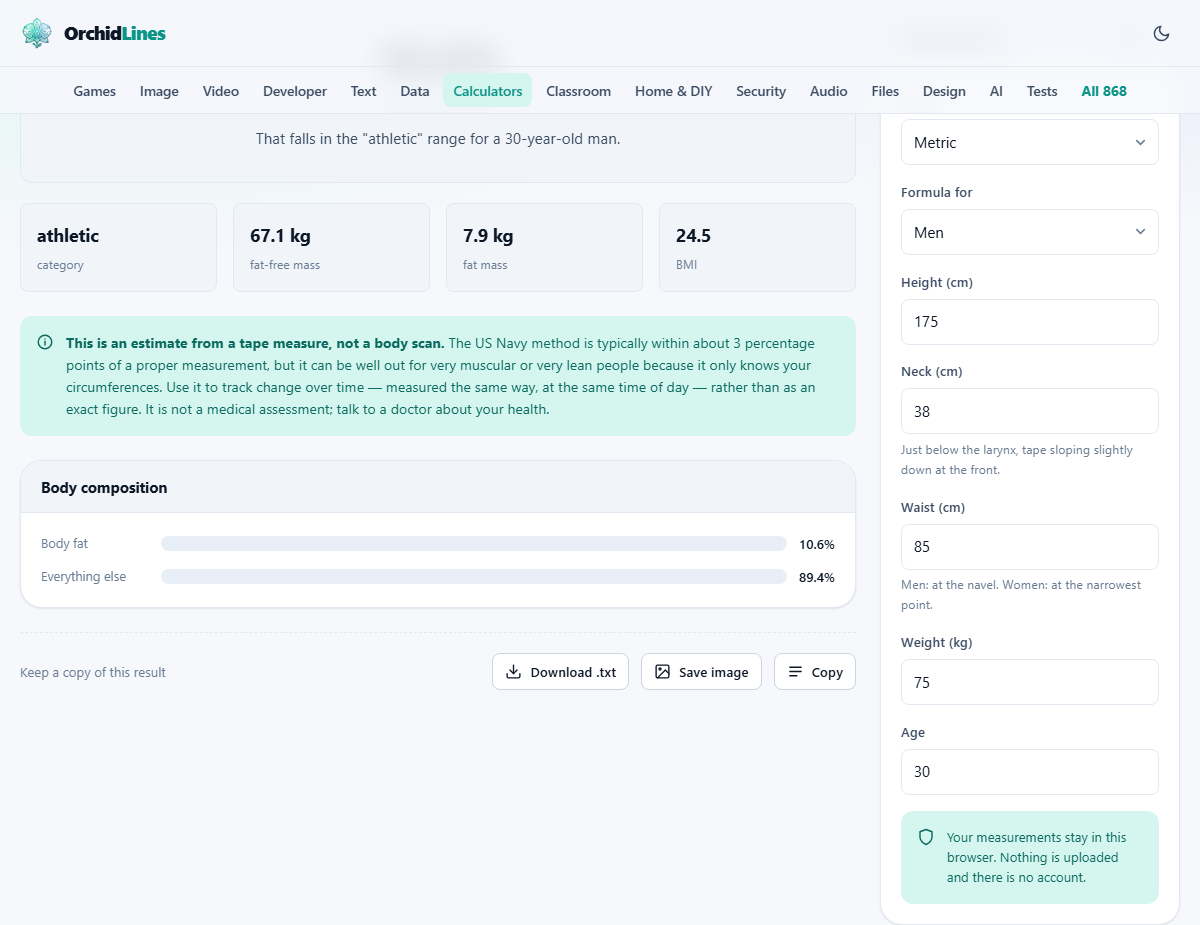
The right-hand panel is headed Measurements. At the top are two dropdowns. Units lets you switch between Metric, which works in centimetres and kilograms, and Imperial, which works in inches and pounds. Every measurement label updates when you change this. Formula for offers Men and Women. This is not a preference; it selects a different formula because the Navy published separate equations for each, and the one for women requires an extra measurement.
Below those two dropdowns you will find boxes for Height, Neck, Waist, and, when the formula is set to Women, Hips. At the bottom, Weight and Age sit side by side. Weight is optional for the body fat estimate itself, but entering it lets the page also show your fat mass and lean mass in actual kilograms or pounds rather than just a percentage.
Where and how to measure
Neck goes just below the Adam's apple, with the tape angled very slightly downward at the front. Keep the tape flat against the skin. Do not flex your neck or pull the tape tight. The goal is a relaxed circumference, not a compressed one.
Waist measurement depends on the formula. For men, measure at the navel. For women, measure at the narrowest point, which is usually a few centimetres above the navel. In both cases, stand upright, breathe out normally, and do not pull your stomach in. The measurement is supposed to reflect how you actually are, not how you wish you were.
Hips appear only when the formula is set to Women. Measure at the widest point of the hips and buttocks, keeping the tape level all the way around. If the tape tilts, the measurement runs long and the estimate drops.
Height is straightforward: stand against a wall without shoes. The formula uses height to scale the circumference measurements against your frame.
Taking good measurements
Tape measurements carry more variability than people expect. The tape can shift by half a centimetre depending on how tightly you hold it, whether you breathe in or out, and even the time of day. Your waist is measurably larger after a big meal and measurably smaller first thing in the morning before eating.
The best practice is to take each measurement three times and average the three. Do it at the same time of day, ideally in the morning before food, and in the same spots every time. This will not make one reading perfectly accurate, but it makes a series of readings over weeks reliable enough to show a real trend.
One specific trap: do not pull the tape tight against the skin. A tape that compresses soft tissue gives a smaller number than the formula expects, and the result will come back unrealistically low. The tape should sit flat and snug, not digging in.
Understanding the output
The headline is your estimated body fat percentage, shown large. Below it you get a category label drawn from the American Council on Exercise ranges. For men these run from essential fat below 5%, through athletic, fitness and average, to above average beyond 24%. For women the same categories use higher thresholds, starting essential fat below 13% and reaching above average past 31%.
A pair of horizontal bars show body fat and everything else as a visual split. If you entered a weight, the page also shows fat mass and lean mass as actual weights and your BMI alongside for comparison. That side-by-side is useful because it lets you see cases where BMI says one thing and body fat says another.
At the foot of the results is a note reminding you that this is a tape-measure estimate, not a body scan. The formula is typically within about three percentage points of a laboratory measurement for people with average builds, but it can miss by more for those at the extremes of muscularity or leanness.
A worked example for men
Set Units to Metric and Formula for to Men. Enter 180 for Height, 39 for Neck, 88 for Waist, 78 for Weight and 32 for Age. The formula converts everything to inches internally because that is how the original Navy equations were defined. It then takes the base-10 logarithm of the difference between waist and neck, the logarithm of height, and combines them.
With those numbers the estimate comes back around 19.5% body fat, which falls in the fitness category. Fat mass is about 15.2 kg, leaving a lean mass of about 62.8 kg. The BMI from the same height and weight is 24.1, which the BMI scale calls healthy. In this case the two measures agree, which is reassuring but not always the case.
Now imagine the waist rises to 95 cm while the neck stays the same. The estimate jumps to roughly 23%, which is still average but noticeably higher. That seven-centimetre difference at the waist moved the result by about three and a half percentage points, which shows how sensitive the formula is to the waist measurement. Getting the tape in the right place matters.
How the formula differs for women
When you select Women in the Formula for dropdown, the Hips field appears. The Navy formula for women uses three circumferences: waist, hip and neck. It subtracts neck from the sum of waist and hips, takes the logarithm, and scales by height.
The extra measurement is there because fat distribution is different. Women typically carry more fat around the hips and less around the internal organs compared to men, and the formula needs that information to produce a reasonable estimate. Leaving out the hip measurement and using the male formula would underestimate body fat for most women.
For a quick example, set Height to 165, Neck to 33, Waist to 72, Hips to 98, Weight to 63 and Age to 28. The estimate comes out around 25%, which sits in the fitness range for women. Fat mass is roughly 15.8 kg and lean mass is about 47.2 kg.
When the estimate goes wrong
The biggest blind spot is muscularity. A person who strength-trains heavily may have a thick waist made of muscle, and the formula reads that as fat. Bodybuilders are routinely overestimated by this method. In the opposite direction, someone who is very lean with little subcutaneous fat can get unrealistically low readings because the formula was calibrated on average military recruits, not competitive athletes.
Unit mismatches are another source of bad results. If you enter centimetres with the page set to Imperial, the numbers will be far too large and the formula may give a result outside its valid range. The page will flag this with an error message, but check your units first if anything looks off.
Measuring in different places each time will also cause confusion. If your waist reading shifts by two centimetres because you measured at the navel one week and the narrowest point the next, that is enough to change the result by a full percentage point. Pick a spot and stick with it.
Tracking change over time
The real value of this tool is not a single reading. Any one measurement taken with a tape has a margin of error that makes the absolute number approximate. What a tape can do well is show direction. If you measure under identical conditions every week for two months, the trend in the numbers will tell you whether you are gaining fat, losing it, or staying about the same, even if each individual reading is a few points off the laboratory truth.
Write down the date, the measurements and the result each time. A spreadsheet or even a notebook works. Over eight to twelve weeks the line tells a story that no single measurement can.
What this tool cannot replace
A tape measure and a formula are not a medical assessment. Body fat percentage is one piece of information about your health, and not even the most important one. Blood pressure, cholesterol, blood sugar, fitness level, sleep quality and mental health all matter, and none of them show up in a circumference measurement.
If you are concerned about your body composition, or if the number you see here surprises you, the right next step is a conversation with a doctor or a qualified dietitian who can look at the full picture. The calculator is a starting point for curiosity, not a diagnosis.
Privacy and storage
All of the arithmetic runs on your own device. The measurements you type are kept in your browser's local storage so that they are still there next time you visit, but they are never uploaded to any server. There is no account and no login. Clearing your browsing data removes the saved values.
That means nobody else can see what you entered, and there is no record on the other end. If you want to keep a history, save it yourself.