
Understanding your BMI, calorie burn and what the numbers actually mean
This article walks through the BMI and calorie calculator step by step. You will learn how to read and enter every field, see a worked example with real numbers, find out where BMI falls short, and understand the calorie estimates it produces alongside the weight index.
Who this is for and what it does
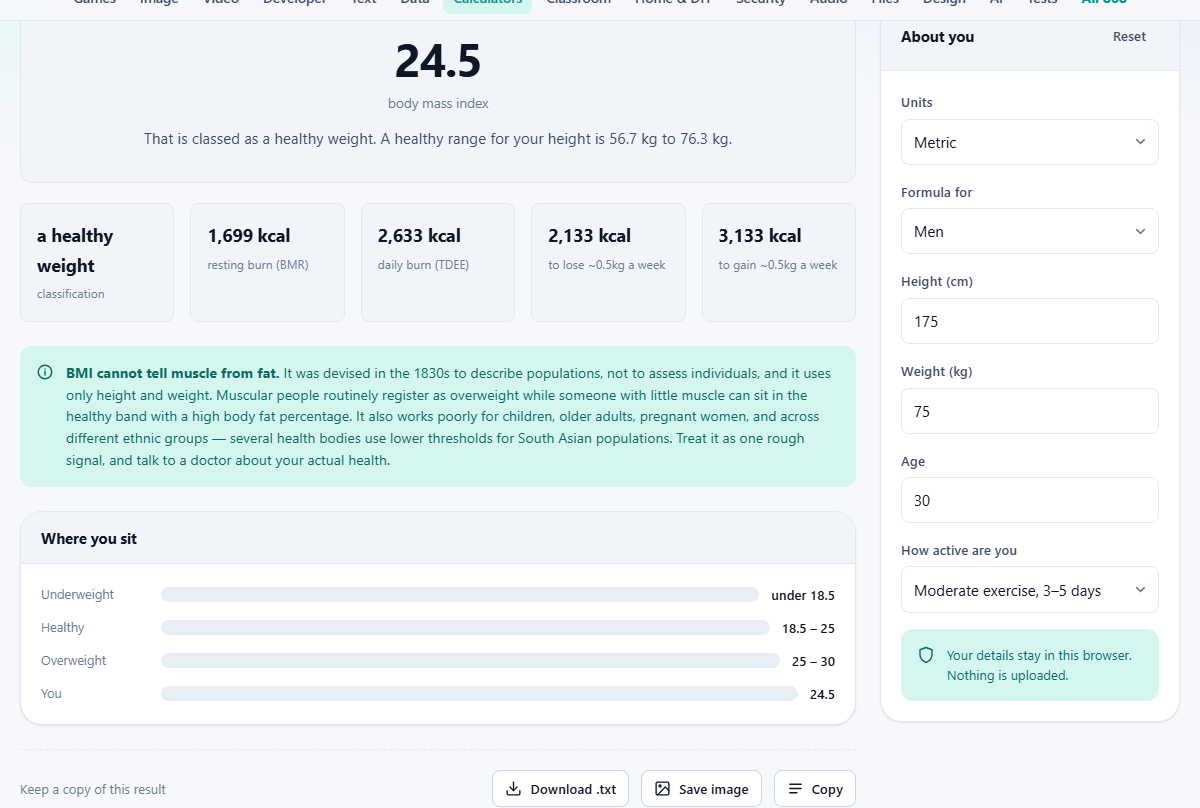
The calculator takes your height, weight, age and activity level and gives you three things at once. First, a body mass index number with the band it falls in. Second, the weight range that would keep you in the healthy band at your current height. Third, a pair of calorie figures that estimate how much energy you burn at rest and across a normal day.
That makes it useful for anyone who wants a quick general snapshot. A runner curious about calorie intake during training will find the daily burn estimate helpful. Someone starting a diet needs the maintenance figure as a baseline. A person who has just been told their BMI by a doctor and wants to understand the scale can look at the bands and the healthy weight range together.
It is not, however, a medical exam. The whole thing rests on two measurements and a formula invented in the 1830s. That is worth keeping in mind while you read the results.
Choosing your units and entering measurements
The panel on the right side is labelled About you. At the top, the Units dropdown lets you pick between Metric and Imperial. Metric asks for height in centimetres and weight in kilograms. Imperial asks for height in inches and weight in pounds. Switching between them changes the labels on the input boxes instantly.
Height and Weight are the two numbers the BMI formula needs. Type them as plain numbers without units attached. If you are working in imperial and your height is five feet ten, convert to total inches first: that is seventy inches. The page does not split feet and inches into separate boxes.
The Formula for dropdown offers Men and Women. This does not change the BMI calculation at all. BMI uses the same formula for everyone. The choice affects only the calorie estimates, because the resting metabolic rate differs between the two.
Age and activity level drive the calorie side
The Age box takes a number between 2 and 120. It has no bearing on your BMI result, but the calorie formula uses it because metabolic rate drops with age. A forty-year-old burns fewer calories at rest than a twenty-year-old of the same size.
How active are you is a dropdown with five options. They run from Desk job, little exercise at the low end through Light exercise, 1-3 days and Moderate exercise, 3-5 days in the middle, up to Hard exercise, 6-7 days and Physical job or twice-daily training at the top. Each one applies a multiplier to your resting burn to estimate total daily energy use. Most people sit somewhere in the first three options. If you are unsure which to pick, go one level lower than your gut says and adjust later based on what actually happens to your weight over a couple of weeks.
Reading the results
The headline number is your BMI, shown large. Below it you see which band it falls in and the healthy weight range for someone of your height. The bands are the standard ones: under 18.5 is underweight, 18.5 to 25 is healthy, 25 to 30 is overweight, and above 30 is obese. A bar chart puts your score alongside these ranges so you can see where you sit at a glance.
Under the BMI you will find four more figures. Resting burn, often called BMR, is the energy your body would use lying in bed all day doing nothing. Daily burn, known as TDEE, multiplies that by the activity factor you chose. The next two lines show a calorie target for losing roughly half a kilogram per week and another for gaining the same amount. These are simply five hundred below and five hundred above your daily burn.
A worked example
Set Units to Metric, Formula for to Men, type 178 in Height and 82 in Weight. That gives a BMI of about 25.9, which falls just inside the overweight band. The healthy range for 178 cm runs from roughly 58.6 kg to 78.9 kg, so this person is a few kilograms above it.
Now add 35 in Age and choose Moderate exercise, 3-5 days. The resting burn comes out near 1,759 kcal and the daily burn near 2,726 kcal. To lose half a kilogram a week, the target would be around 2,226 kcal a day. To gain at the same rate, around 3,226 kcal.
Change Formula for to Women with the same height and weight. The BMI stays the same because height and weight have not changed. The calorie numbers drop because the resting formula subtracts more for women, landing the daily burn closer to 2,479 kcal instead.
Where BMI goes wrong
BMI was created by a Belgian statistician named Adolphe Quetelet to study populations, not individuals. It divides weight by the square of height and stops there. It has no idea whether a given kilogram is muscle, fat, bone or water.
This matters in practice. A rugby player carrying a lot of muscle will register as overweight or obese while having a perfectly normal body fat percentage. A person who does no exercise and carries little muscle might sit comfortably in the healthy band while actually having more body fat than is good for them. The number is the same formula for both, and it cannot tell them apart.
It is also less reliable at the extremes of height. Very tall people tend to get higher scores and very short people lower ones, not because of their body fat but because the squaring in the formula does not scale perfectly. Children, older adults and pregnant women are poorly served too, and several health organisations now use lower thresholds for people of South Asian descent because the relationship between BMI and health risk differs across ethnic groups.
None of that means the number is useless. Across a large group, it does correlate with body fat. For a single person, it is best treated as one rough indicator among several, and a waist measurement or a body fat estimate is usually more informative.
How the calorie estimates are made
The resting burn uses the Mifflin-St Jeor equation, which is the same one most clinical nutrition guidelines now recommend. It takes weight in kilograms, height in centimetres and age in years, applies different constants for men and women, and gives a number in kilocalories. The formula tends to be more accurate than the older Harris-Benedict equation for most body types, but it is still an estimate based on averages.
The daily burn multiplies the resting figure by an activity factor. The lowest factor is 1.2 for a sedentary person, and the highest is 1.9 for someone in heavy physical work or training twice a day. These multipliers come from published research but they are broad categories, and real life sits between them. Two people who both pick moderate exercise may burn quite different amounts depending on their exact routine, body composition and metabolism.
Common mistakes and how to avoid them
The most frequent error is mixing up units. If your scale reads in kilograms but you have set the page to Imperial, the BMI will be wildly off. If the result looks impossible, check that box first.
Another common slip is overestimating how active you are. A thirty-minute gym visit three times a week with long rest breaks between sets is closer to light exercise than moderate. This does not affect BMI, but it inflates the calorie number and might lead you to eat more than you actually burn.
Some people also enter their height in feet rather than total inches when using Imperial. Five foot ten is not 5.10 inches; it is 70 inches. The page works in a single number for height, not a feet-and-inches pair.
Finally, the five hundred calorie deficit for weight loss is a rough average, not a law. It assumes a rate of about half a kilogram per week, which is generally considered sustainable. A larger deficit may work faster on the scales but tends to cost more muscle and is harder to stick with.
When to use a different tool instead
If you are interested in body composition rather than a single index number, the Body Fat Calculator on the same site is a better starting point. It uses tape measurements at the neck, waist and hips to estimate how much of your weight is fat and how much is everything else. That distinction is exactly what BMI cannot make.
If you are an athlete tracking performance, BMI has almost nothing to offer you. A body fat percentage and lean mass figure will tell you far more about whether your training is building muscle or losing fat.
And if a medical professional has flagged your weight as a concern, the correct next step is a conversation with them, not a web page. No calculator can account for your medical history, medications, hormones or family background.
Privacy and where your data lives
Every calculation runs entirely on your own device. Your height, weight, age and activity level are not sent to any server. There is no account, no login and no way for anyone on the other end to see what you entered.
The page saves your inputs in your browser's local storage so that you find the same numbers when you come back. That storage is tied to this browser on this device only. Clearing your browsing data removes it. If you want a permanent record, write down the results or use the download option.