
Using the baker's percentage calculator to get hydration, salt and starter right
This guide explains every input on the baker's percentage calculator, covers the three starting modes, walks through a real sourdough loaf with actual gram weights, and shows why the flour and water in your starter must be counted separately to get the true hydration of your dough.
What baker's percentages are and why they exist
In a bakery, every ingredient is written as a percentage of the total flour, not as a percentage of the total dough. Flour is always 100 percent by definition. If a recipe calls for 70 percent hydration, that means the water weighs 70 percent of whatever the flour weighs. If the flour is 1000 grams, the water is 700 grams.
This system has one enormous advantage: a formula in baker's percentages scales to any size without any conversion. The same recipe works for one loaf or for two hundred, because the ratios between ingredients never change. You just decide how much flour you want and multiply everything by the same factor. That is exactly why bakeries around the world write recipes this way.
It also means the percentages always add up to well over 100, which confuses people the first time they see it. A simple loaf at 70 percent hydration and 2 percent salt has percentages that sum to 172. That is normal and correct. The 100 is the flour, the 70 is the water, and the 2 is the salt.
Choosing a starting point with the Start from selector
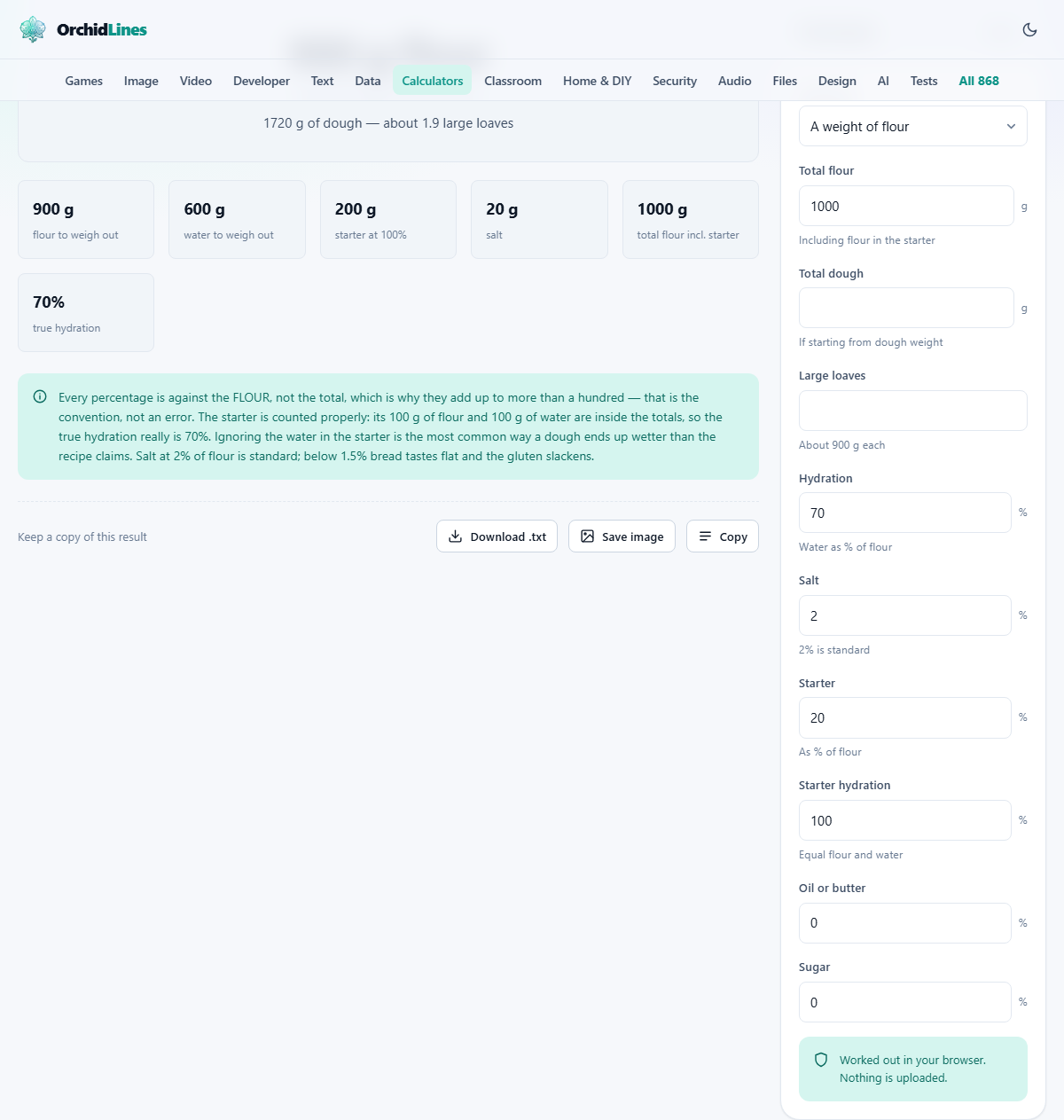
The first control in the panel headed The formula is a dropdown labelled Start from with three choices. A weight of flour means you already know how much flour you have and want the calculator to work out everything else. This is the default and the most common starting point.
A total dough weight is the second option. Here you type a dough weight and the calculator works backward to the flour, water, salt and starter behind it. Watch the dough figure it reports, because it lands under the number you typed by roughly the starter percentage. Ask for 900 grams with a 20 per cent starter and the dough comes out near 806 grams. Nudge your target up until the reported weight is the one you wanted.
A number of loaves is the third option. It counts a large loaf as 900 grams of dough and builds the ingredient list from there, with the same shortfall as the dough mode: ask for two loaves and the dough comes to about 1,613 grams rather than 1,800. The line under the headline tells you how many loaves the dough really makes, so raise the count until that reads right. For a different loaf size, use the dough weight mode.
The percentage fields: hydration, salt, starter and extras
Hydration is the water as a percentage of the flour. The default is 70 percent, which gives a manageable dough for a standard white loaf. Lower values, around 60 to 65 percent, produce a tighter crumb suited to sandwich bread or tin loaves. Higher values, 75 to 80 percent and above, give the open crumb of a ciabatta or a rustic sourdough. The dough gets stickier and harder to shape as the number rises.
Salt is set at 2 percent by default. This is the standard for most bread. Below about 1.5 percent the bread tastes flat and the gluten structure weakens. Above 2.5 percent the salt begins to hold back the yeast noticeably.
Starter is the amount of sourdough culture as a percentage of the flour. The default is 20 percent. A higher starter percentage speeds up fermentation, which matters in a warm kitchen or when you want the bread ready sooner. A lower percentage gives a longer, slower rise with more developed flavour.
Oil or butter and Sugar are both set to zero by default. They are there for enriched doughs: brioche, challah, sweet rolls, or any bread that includes fat or sugar. Entering a number here adds the ingredient to the output at that percentage of the flour.
Why starter hydration changes the flour and water you add
The field labelled Starter hydration controls how the starter's own weight is split between flour and water. At the default of 100 percent, the starter is half flour and half water by weight. That means 200 grams of starter contains 100 grams of flour and 100 grams of water.
The calculator counts that flour as part of the total flour, and that water as part of the total water. It then subtracts both from the amounts you need to add separately. This is the whole reason the calculator exists: getting this split right by hand is fiddly and easy to get wrong.
A recipe that says 75 percent hydration but ignores the water hiding in 200 grams of 100 percent hydration starter is really running at about 79 percent. That four-point difference is the gap between a dough you can shape and one that spreads flat. The calculator does the honest accounting for you.
If your starter is not at 100 percent hydration, set the actual figure. A stiff starter at 50 percent has much more flour than water. A liquid starter at 125 percent is mostly water. The calculator adjusts the split and changes the added flour and water to match.
A worked example: a single sourdough loaf
Start with 500 grams of flour. Set hydration to 72 percent, salt to 2 percent, starter to 20 percent and starter hydration to 100 percent. Leave oil and sugar at zero.
The total flour is 500 grams. The starter is 20 percent of 500, which is 100 grams. At 100 percent hydration, those 100 grams of starter contain 50 grams of flour and 50 grams of water. The flour you actually add to the bowl is 500 minus 50, which is 450 grams.
Total water at 72 percent of 500 grams is 360 grams. Subtract the 50 grams already in the starter, and the water you add is 310 grams. Salt at 2 percent of 500 is 10 grams.
The dough weight is 450 plus 310 plus 10 plus 100, which comes to 870 grams. After baking, water loss brings that down to roughly 780 grams, which is a good-sized loaf. Every number here matches what the calculator shows when you enter the same inputs.
Flour types and why the same hydration feels different
Whole wheat flour and rye flour absorb far more water than white flour. A dough at 70 percent hydration made entirely with white flour feels soft and workable. The same percentage with whole wheat flour feels dry and stiff, because the bran in the grain soaks up water that would otherwise keep the dough loose.
The calculator does not know which flour you are using, and it does not need to. The percentages it produces are correct for any flour. But you need to know that a hydration target built for white flour will probably need to be raised by five to ten percentage points when you switch to whole wheat.
Blended flours, such as half white and half whole wheat, land somewhere in between. The only reliable way to find the right hydration for a particular flour is to bake with it, which is why experienced bakers treat the number as a starting point rather than a fixed rule.
Common mistakes when using baker's percentages
The most common mistake is forgetting that the starter contributes flour and water. If you add the full flour amount and the full water amount and then also add the starter, the total dough is heavier and wetter than intended. The calculator handles this by showing two figures: the total flour (including what is in the starter) and the flour to add (which is less).
Another frequent error is confusing baker's percentages with regular percentages. In baker's percentages, the numbers always add up to more than 100. Someone who sees 70 percent hydration and thinks the dough is 70 percent water is reading the figure as a fraction of the whole, which it is not. It is 70 percent of the flour weight, and the flour is only part of the dough.
Scaling errors also happen when people multiply only some of the ingredients. The whole point of baker's percentages is that every ingredient scales by the same factor. If you double the flour, you must also double the water, the salt and the starter. The calculator prevents this by doing the multiplication for you.
When baker's percentages are not the right approach
Baker's percentages work for any dough where flour is the main ingredient. They do not work well for recipes where flour is a minor component, such as a cake batter that is mostly eggs and sugar, or a pancake mix that is half liquid. Those recipes are better expressed as straight weights.
They are also not helpful for recipes with no flour at all, obviously. Gluten-free baking that uses starches and gums instead of flour has its own scaling conventions.
Privacy and where the maths runs
The calculator runs entirely on your own device. No ingredient list is sent to a server and no account is needed. You can use it freely and adjust the numbers as many times as you like. The formula you leave on screen is written to this browser's own local storage, so the same recipe is waiting the next time you bake; Reset throws that copy away. Nothing goes anywhere else.
The page works offline once it has loaded, so you can keep it open on a phone or tablet in the kitchen without needing a network connection while your hands are covered in dough.