
How the blood alcohol estimator uses the Widmark formula and why you must not drive on its say-so
This guide explains every field on the blood alcohol estimator, walks through the Widmark formula behind it, works a full example with concrete drink counts, and makes clear why the time-to-zero figure is useful but the number itself must never be treated as permission to get behind a wheel.
What the estimator calculates and what it cannot tell you
The page takes the drinks you have had, your body weight and the time that has passed, and returns an estimate of blood alcohol concentration using the Widmark formula. It also shows roughly how many hours remain until that concentration reaches zero.
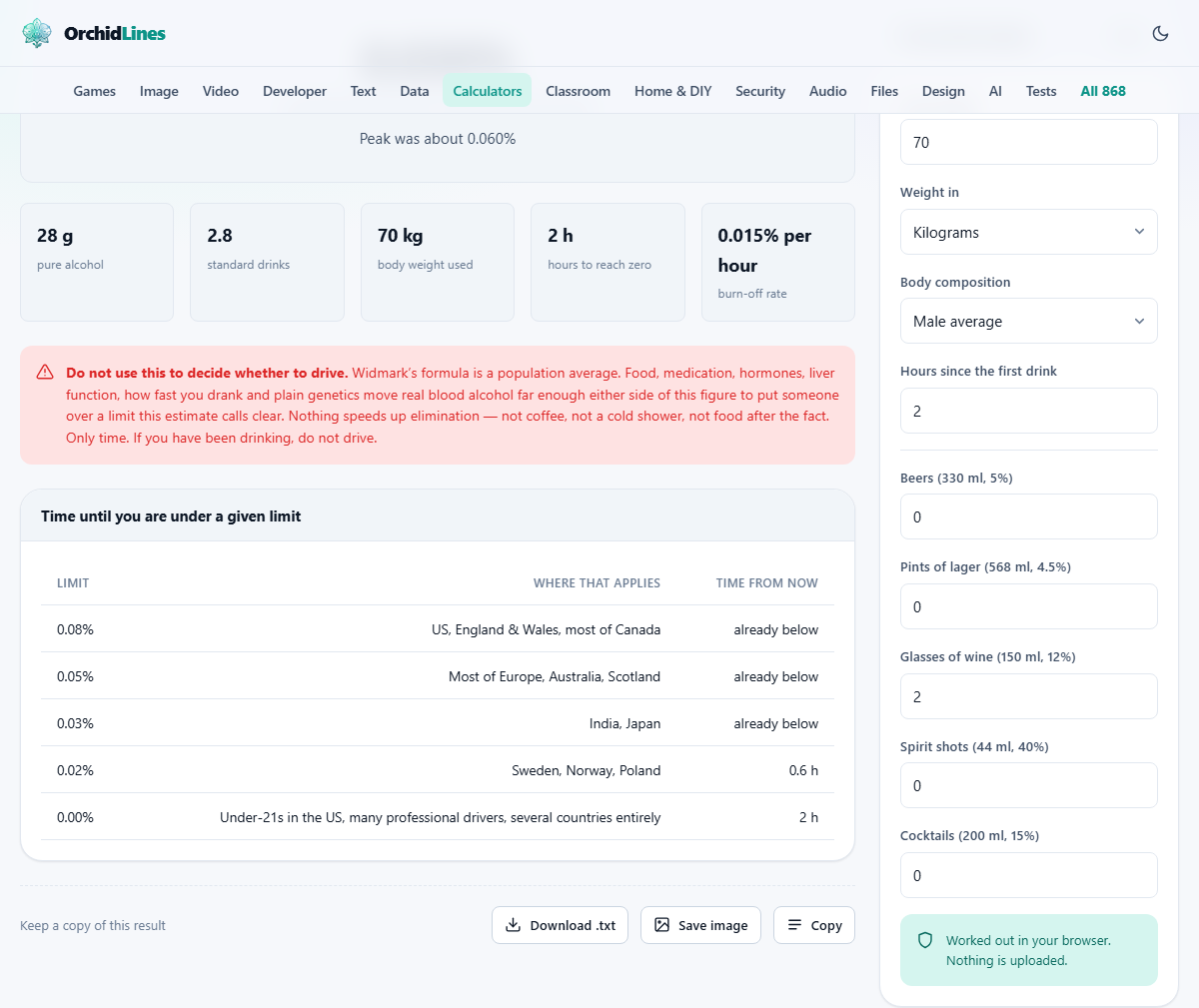
What it cannot tell you is whether you are safe to drive. Real blood alcohol varies with food, medication, hormones, liver health, drinking speed and genetics by enough to push someone over a legal limit that this estimate calls clear. The tool exists to show how slowly alcohol leaves the body, not to help anyone find the edge of the law. If you have been drinking, do not drive.
The audience for this tool is broad. A medical student studying pharmacokinetics. A health educator preparing a lesson on alcohol metabolism. A curious person who wants to understand why they still felt the effects of two glasses of wine eight hours after dinner. The maths is interesting, and the result is usually sobering in more than one sense.
The body fields: weight, units and composition
The panel headed You and the drinks holds all the inputs. Body weight is a number field, and the Weight in dropdown lets you choose between Kilograms and Pounds. The formula needs weight in kilograms internally, so if you enter pounds the tool converts for you.
Body composition offers three choices: Male average, Female average and Population average. This controls the Widmark distribution ratio, which reflects how much of your body weight is water. Alcohol dissolves in water, so a higher water fraction means a lower concentration for the same amount of alcohol. On average, male bodies carry a higher water fraction than female bodies, which is why the same number of drinks produces a higher reading for the female average setting. Population average sits between the two.
Counting the drinks
Below the body fields is a row of drink categories, each with a count you can raise or lower. The five types are Beers at 330 ml and 5 percent, Pints of lager at 568 ml and 4.5 percent, Glasses of wine at 150 ml and 12 percent, Spirit shots at 44 ml and 40 percent, and Cocktails at 200 ml and 15 percent.
Each category gives a volume and an alcohol percentage so you know what it is counting. A home pour is almost always larger than the measured sizes listed here. If your glass of wine was closer to 200 ml than 150, you should count it as one and a third glasses, or simply round up to two. Underestimating the amount is the single most common way the estimate comes out too low.
The tool works in grams of pure alcohol internally. Each drink type is converted using its volume and percentage, so mixing different drink types in one session is handled correctly.
The time field and how elimination works
Hours since the first drink tells the formula how long your liver has been working. The average elimination rate is about 0.015 percent per hour, and the formula subtracts that rate multiplied by the number of hours from the raw concentration.
This means time matters as much as quantity. Two glasses of wine three hours ago gives a very different number from two glasses of wine thirty minutes ago. The liver began clearing alcohol as soon as it arrived in the bloodstream, and every hour that has passed reduces the estimate.
Nothing speeds up elimination. Coffee, cold water, exercise, food after drinking, a shower: none of these change the rate. They may make a person feel more alert, but the liver clears alcohol at its own pace and only the passage of time brings the number down. The tool makes this plain by showing you the hours remaining.
A worked example with real numbers
A person weighing 70 kilograms, using the male average setting, has had two glasses of wine over dinner. Two hours have passed since the first glass. Each glass is 150 ml at 12 percent, so the total alcohol is about 28.4 grams.
The Widmark formula converts that into a blood concentration by dividing the alcohol in grams by the body weight in grams multiplied by the distribution ratio, which is 0.68 for the male average. The raw figure comes out around 0.060 percent. Subtracting two hours of elimination at 0.015 per hour removes 0.030, leaving an estimate around 0.030 percent.
The time-to-zero figure says roughly two more hours until the concentration reaches zero. That means the total clearance time from the first drink is about four hours for two glasses of wine. Many people are surprised by how long that takes.
Now change the setting to female average, which uses a distribution ratio of 0.55. The same two glasses on the same body weight produce a higher raw figure, and the time-to-zero grows to about three more hours. The body composition setting is not a minor detail.
The morning-after problem
The most dangerous situation the tool can illustrate is the morning after a heavy night. Suppose someone weighing 80 kilograms had eight pints of lager between seven in the evening and midnight, then went to sleep and got up at seven the next morning. That is twelve hours since the first drink.
Eight pints at 568 ml and 4.5 percent is about 161 grams of pure alcohol. On the male average setting the peak is roughly 0.297 percent, and twelve hours of elimination takes off 0.18 of that. The reading at seven in the morning is still about 0.117 percent, which is over the 0.08 limit, with nearly eight more hours to go before zero. This catches people off guard because they feel rested and sober, but the liver has not finished the job. Try the same night with five pints instead and the morning reading drops to about 0.005 percent, near enough clear — the gap between those two nights is only three pints.
Running those numbers through the calculator is the single most useful thing this tool does. It shows that sleeping does not reset anything. The clock has been running, but whether it has run long enough depends on how much was consumed.
Common mistakes and misunderstandings
The biggest mistake is treating the output as a green light to drive. The formula uses population averages. An individual can differ by tens of percent in either direction, which is the difference between being under a legal limit and being over it. No online calculator can measure your actual blood alcohol. Only a proper test can do that.
Underestimating drink sizes is the second most common error. Pub measures and home pours are different things. A large glass of wine in a restaurant is 250 ml, not 150. A strong beer may be 7 percent, not 5. If you are not sure, count more rather than fewer.
Forgetting to count the drinking time accurately also skews the result. If the first drink was at seven but you entered two hours instead of three, the elimination subtraction is too small and the estimate comes out higher than reality. The reverse mistake, entering too many hours, makes the estimate too low, which is the more dangerous error.
When this estimator is the wrong tool
Any time the answer matters for safety, this is the wrong tool. If you need to know whether you are over a legal limit, the only reliable method is a calibrated breathalyser or a blood test. A formula built on population averages cannot account for your genetics, your liver, what you ate, or any medication you are taking.
The estimator also does not cover other ways alcohol is detected. Urine tests and hair tests can find traces of alcohol long after it has left the blood. The time-to-zero figure here is about blood concentration only.
For tracking long-term drinking patterns or alcohol dependency, a medical professional is the right resource, not a calculator on a website.
Privacy and how the calculation runs
The estimator runs entirely on your own device. Your weight, your body composition setting and the drinks you enter are never sent anywhere. There is no server involved and no account required. The page works offline once loaded.
This is especially important for a tool that deals with personal health information. You can explore the numbers honestly, without worrying that anyone is watching or recording what you type. One caveat is worth knowing: the entries are written to this browser's own local storage so the page still has them next time. Press Reset to clear that copy, and use a private window if you would rather nothing was kept at all.