
Estimating your one-rep max from a set you already did
Testing a true one-rep max is hard on your body and takes a full session to recover from. Most lifters never need to do it, because a set of a few reps at a known weight gives a reliable estimate. This article explains the two formulas behind the calculator, walks through each control, shows a worked example with real numbers, and covers the mistakes that lead to bad estimates.
What a one-rep max is and why it matters
A one-rep max is the heaviest weight you can lift once with good form. It is the anchor for most strength programmes, because those programmes prescribe working weights as percentages. A programme that asks for five sets of five at seventy per cent is useless until you know seventy per cent of what.
Testing it directly means loading a bar to a weight you have never lifted and trying. That carries real risk, demands a spotter, and takes enough out of you that the rest of the session is written off. So lifters estimate instead. Take a hard set you already did, feed the weight and reps into a formula, and the output is a close approximation of the single you could have done.
The two formulas and how they differ
The Epley formula multiplies the weight by one plus the reps divided by thirty. In plain terms, it adds a fraction of the weight for each rep beyond one. It was published in 1985 and is the most widely cited version.
The Brzycki formula divides the weight by a factor that decreases as reps increase, reaching zero at about 37 reps. It was published in 1993 and tends to give a slightly lower estimate at high rep counts. Between 2 and 6 reps Brzycki sits about 3 to 4 per cent below Epley. From there the two close on each other: the gap is under 3 per cent at 7 reps and about 1 per cent at 9, before they meet at 10.
The two lines cross twice. At 1 rep both simply hand back the weight you typed. At 10 reps they meet again, because both work out to the weight times four thirds. Past 10 reps they pull apart the other way, with Brzycki now the higher of the pair, and by 15 reps the gap is about 9 per cent. The calculator shows both results and headlines their average, which is a fair guide rather than a precise number.
The controls on the page
Weight lifted is the load you used for the set. Type the number you actually put on the bar, in whatever unit you normally think in.
Reps completed is how many clean repetitions you finished. The field accepts one through fifteen. Above fifteen the relationship between reps and maximal strength breaks down because the set is testing endurance, not peak force. The calculator declines rather than producing a number that would be false precision.
Units lets you pick Kilograms or Pounds. The formulas work the same in either unit because they are ratios, not absolute values. The percentage table in the output will show weights in whichever unit you choose.
Reset throws away the copy of your entries that the page keeps in this browser, then works the answer out again. It does not wipe the boxes, so type over them when you want new numbers.
A worked example with a squat set
You squatted 120 kilograms for five reps to near failure. Type 120 into the Weight lifted field and 5 into Reps completed. Leave Units on Kilograms.
The Epley formula gives 120 times one plus five divided by thirty, which is 120 times 1.167, giving 140 kilograms. The Brzycki formula gives 120 divided by 1.0278 minus 0.0278 times five, which works out to roughly 135 kilograms. The average of the two is about 137 or 138 kilograms.
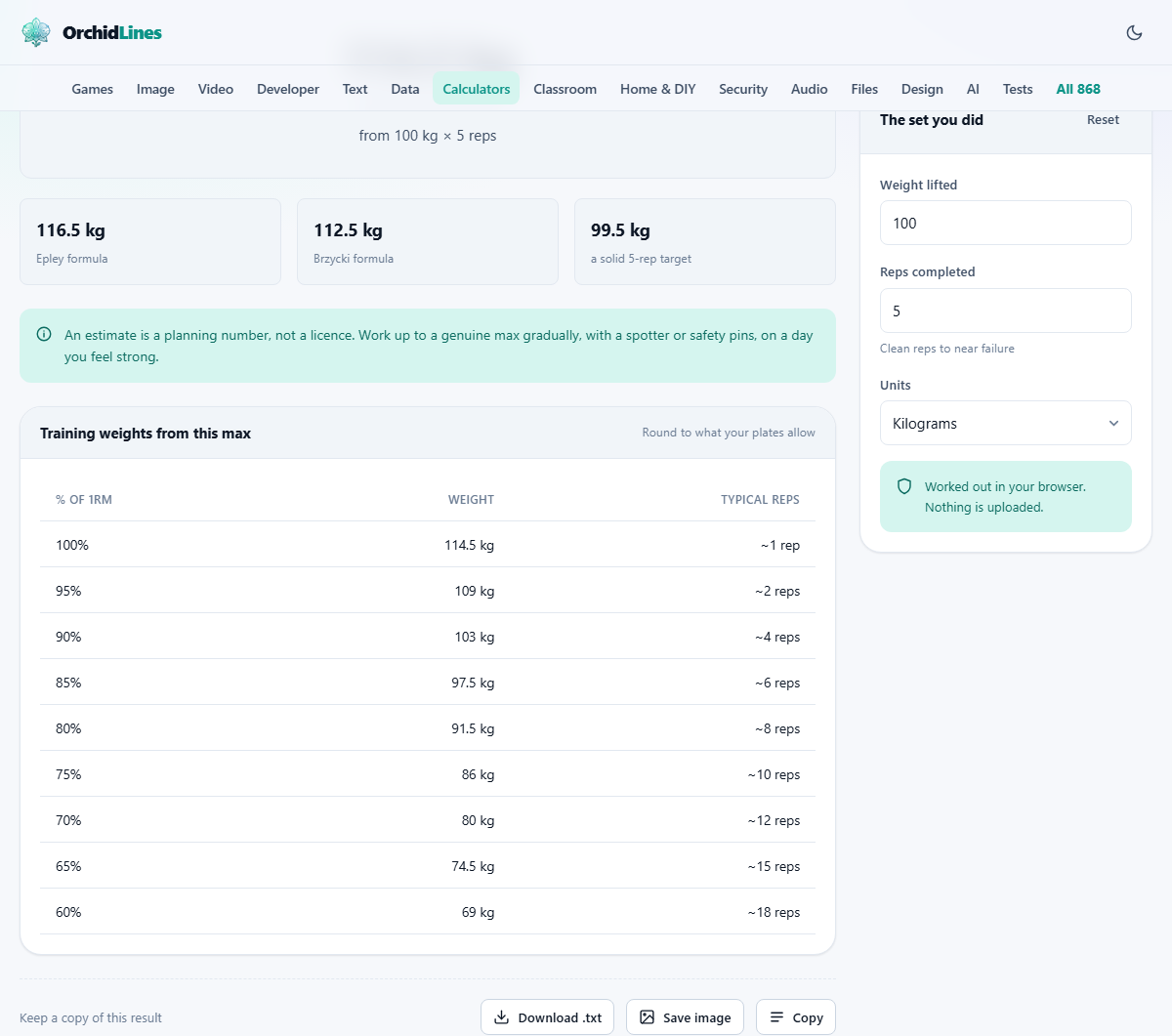
Below the main estimate, a percentage table appears. It lists nine rows, from 100 per cent down to 60, each with the matching weight and a rough note of how many reps that percentage usually allows. If your programme says to do working sets at 80 per cent, the table tells you that is about 110 kilograms. No mental arithmetic needed. Just look up the row.
Why low reps give better estimates
A set of three reps is a much better predictor than a set of twelve. The reason is simple: a low-rep set is close to the thing being estimated. A heavy triple is only a small step from a single, so the formula does not need to extrapolate far. A set of twelve is a long way from a single, and the path from endurance to peak force is not a straight line for everyone.
Muscle fibre type, fatigue tolerance, technique breakdown under load, and even caffeine intake all affect how reps relate to maximal strength. At three reps, those individual differences barely matter. At twelve reps, they can swing the estimate by ten per cent or more.
If your only recent hard set was a high-rep one, use the estimate as a starting point but be ready for the real number to be noticeably different. If you can, do a heavy set of three to five next session and recalculate.
Reps in reserve and honest input
The formulas assume the set was taken to failure or very close to it. If you stopped your set of five with two more reps in the tank, the weight you entered is not your true five-rep max, and the estimate will read low.
The opposite happens when form breaks down. If the last two reps were ugly, with your hips shooting up on the squat or your back rounding on the deadlift, those reps were technically completed but not at the standard you would use for a max attempt. The estimate will read high.
Feed the calculator sets that were genuinely hard and genuinely clean. A set where you ground out the last rep with good form is the ideal input. Anything else shifts the number in a direction that will bite you when you try to use it.
Differences between lifts
The formulas were developed from data on compound barbell lifts, and they work best there. Squats and deadlifts tend to hold up well over reps, so the estimate for those lifts is often accurate. Bench press is less predictable because the sticking point changes character as fatigue builds, and most people fail a bench rep more abruptly than a squat rep.
Overhead press sits somewhere in between. The lift is strict enough that fatigue is obvious, but the muscles involved are smaller, so the gap between a five-rep set and a true single can be wider than the formulas predict. If you are pressing, estimate from a set of three rather than a set of five.
For isolation exercises like a bicep curl or a lateral raise, the whole idea of a one-rep max is mostly academic. Nobody programmes a lateral raise at 85 per cent of a tested max. If you do run the numbers for an isolation lift, treat them as rough and remember that the formulas were not designed for that purpose.
Safety first, always
A calculated number is not a licence to load the bar and go. If your estimate says 140 kilograms but you have never lifted more than 120, treat 140 as a target for later. Work up in steps over several sessions. Use safety pins set at the right height. Have a spotter you trust.
Test a max only on a day you feel strong, slept well, and are not carrying fatigue from the week's training. A bad day can easily cost ten per cent, which on a 140 kilogram estimate means you are trying to lift through 126 kilograms that feel like 140. That is where injuries happen.
Recalculate every few weeks from a fresh hard set. Strength changes faster than most people expect, in both directions, and an old estimate drifts further from reality with each passing week.
Using the percentage table in practice
Below the main estimate, the calculator produces a table of percentages. Each row shows a percentage of your estimated max, the weight it comes to, and roughly how many reps that load tends to allow. This is the part most people actually use week to week, because strength programmes almost always speak in percentages.
A typical linear programme might prescribe three sets of five at 75 per cent on Monday and five sets of three at 85 per cent on Friday. Without the table you would need to multiply your max by 0.75 and then by 0.85, round to the nearest plate you own, and hope you did the arithmetic right. With the table, you read off the weights directly.
Round the table's numbers to whatever your plates allow. If the table says 103 kilograms and your smallest plates are 1.25 kilogram, load 102.5. A half kilogram either way makes no practical difference, and chasing exact numbers wastes time that would be better spent warming up.
Where the calculation runs
The maths is done entirely in your browser. No data is sent anywhere, no account is needed, and the page works offline once loaded. Your training numbers stay on your own device.