
Buying the right number of rolls on the first trip
Why the pattern repeat decides how many rolls you need, what the difference between a straight match and an offset match costs, how to handle doors and windows, and why you should always buy one extra.
The repeat changes everything
A plain wallpaper with no pattern cuts cleanly at the wall height. Every piece is the same length, and almost nothing goes to waste. Add a pattern repeat and the picture changes completely.
Each drop of patterned paper must be cut to a whole number of repeats, so that the design meets across the seam when the next strip goes up. That means the cut length is nearly always longer than the wall is tall. The leftover at the top and bottom of every strip is trimmed off and thrown away.
A large repeat wastes more. At a 2.4 metre ceiling height, a plain paper gives four full drops from a standard 10 metre roll. Add a 640 millimetre repeat and each drop has to be cut longer to line up the pattern, so you get only three drops from the same roll. That is a third more rolls for the same room, and the repeat is the only thing that changed.
Straight match and offset match
A straight match means the pattern sits at the same height on both edges of the strip. Every drop starts at the same point, and the waste at the top and bottom is the same for each one.
An offset match, sometimes called a drop match, is different. The pattern on one edge is shifted down by half a repeat compared to the other edge. That means alternate strips start half a repeat lower. The first strip might start at the top of the repeat, and the second starts halfway through it.
The offset adds roughly half a repeat of extra waste to every second strip. Over a full room that pushes the roll count up by about half a repeat per drop, which can mean one or two more rolls than a straight match of the same size.
The label on the roll tells you which type it is. A pair of arrows pointing straight across means a straight match. Arrows at different heights mean an offset.
Filling in the panel
Wall length to cover is the total length of all the walls you are papering. Measure right round the room, including the wall the door is in. The door is handled separately by the openings field lower down.
Wall height is the floor-to-ceiling measurement. If there is a picture rail or a dado rail and you are only papering above or below it, use that height instead of the full wall.
Roll length and roll width default to the European standard: 10.05 metres long and 530 millimetres wide. American rolls are different, so check the label and change these if needed. Some brands sell double rolls, which are twice as long. Enter the actual length of whatever you are buying.
Pattern repeat is in millimetres. It is printed on the label of every patterned roll. For a plain paper or a random texture with no visible repeat, put zero.
Doors, windows and the openings field
The openings field asks how many whole drops are saved by doors and windows. This is not the number of doors and windows. It is the number of full-width strips you do not need to hang because an opening takes up the entire width.
A standard door saves about one drop. A wide patio door might save two. A large window saves one if it is at least as wide as a strip of paper. A small window, anything under about a metre wide, rarely saves a drop, because the strips on either side still need to run full height and the offcut above the window is too short to reuse.
Count conservatively. A door with a strip of wall above it still needs a partial piece for that strip, so calling it a full saved drop is slightly generous but usually close enough. When in doubt, do not subtract it.
What the result tells you
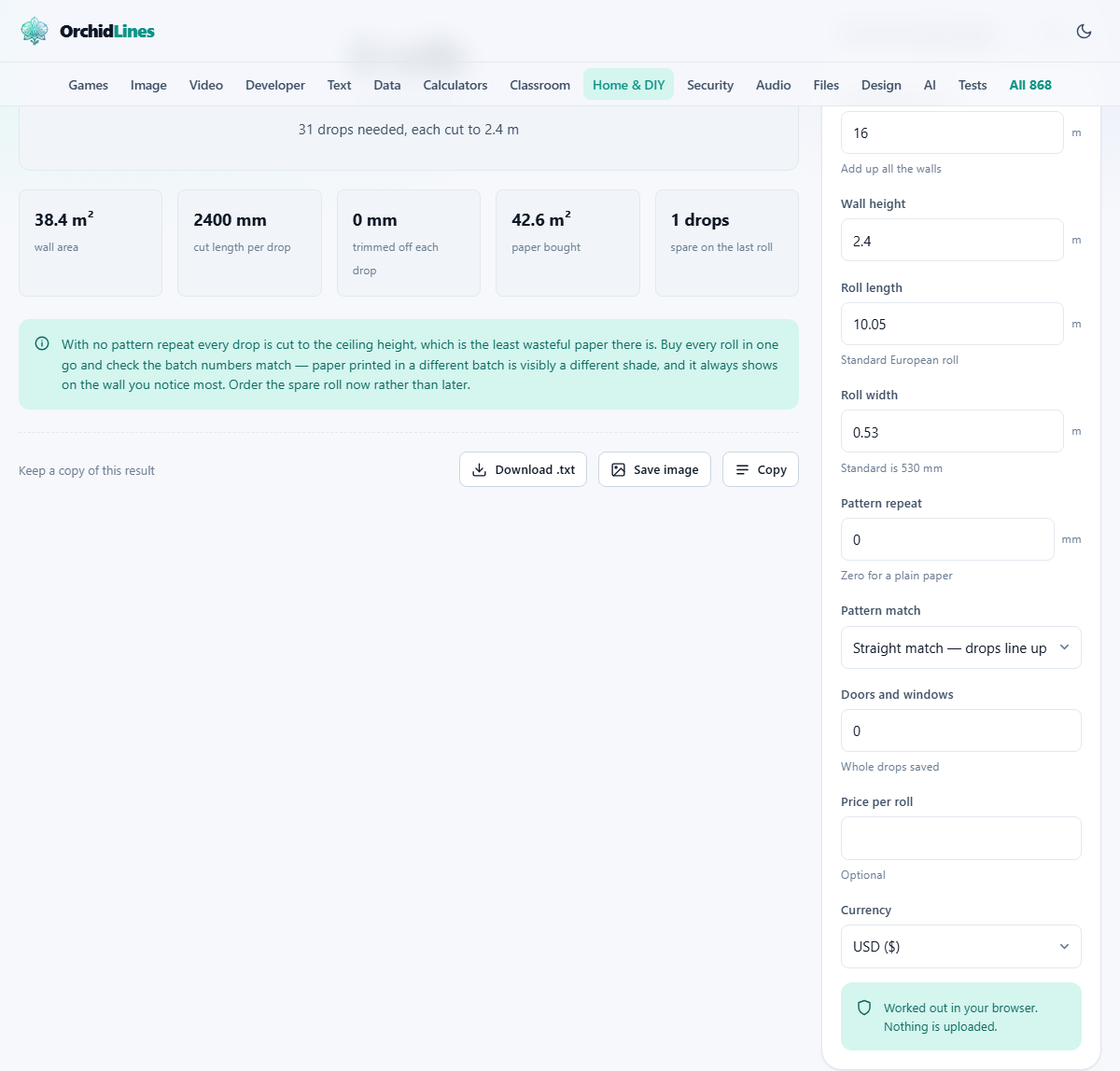
The calculator shows the total number of drops the room needs, the cut length of each drop after the repeat is accounted for, how many drops come off each roll, and therefore the total number of rolls.
The cut length is the number to watch. On a plain paper it equals the wall height plus a small trim allowance. On a patterned paper it is the wall height rounded up to the next whole repeat, plus extra for an offset if that applies. The bigger this number, the fewer drops fit on a roll and the more rolls you need.
If you filled in a price per roll, the result also shows the total cost. This is useful when comparing two papers with different repeats, because the cheaper paper per roll can end up costing more if its repeat wastes more material.
A worked example
A room measures 16 metres around all four walls. The ceiling is 2.4 metres high. The paper is a standard European roll, 10.05 metres long and 530 millimetres wide, with a 530 millimetre straight match repeat.
Each drop must cover 2.4 metres of wall. The repeat of 530 rounds that up to five full repeats, which is 2,650 millimetres per drop. A 10.05 metre roll gives three drops at that length, with about 2.1 metres of waste.
The room needs 31 full drops to cover 16 metres at 530 millimetres wide. At three drops per roll, that is 11 rolls. Subtract one drop for the door and the count drops to 30 drops, still 10 rolls.
Switch to the same paper with an offset match. The alternate drops now need half a repeat extra, pushing their cut length to roughly 2,915 millimetres. Fewer of them fit on a roll, so the total rises to 12 rolls. The offset alone has cost one extra roll.
Shopping advice that saves a second visit
Buy one more roll than the calculator says. A spare costs less than finding out mid-wall that you are one short and the batch has sold out. Unopened rolls can usually be returned.
Check the batch numbers on every roll before you leave the shop. Wallpaper from a different print run is a visibly different shade, even if the pattern is the same. Buy all your rolls at once, including the spare, and make sure every box carries the same batch code.
Keep one roll wrapped and stored flat. Dye lots are retired regularly, and a replacement roll six months later may not match. The wrapped spare is your insurance against a tear, a stain or a badly hung drop that needs to be redone.
Feature walls and non-standard rooms
For a single feature wall, enter just that wall's width as the wall length instead of the full room perimeter. The roll count will be much lower, but the repeat still matters because the drops still have to align.
A room with a sloped ceiling, such as an attic bedroom, needs the tallest wall height entered. The drops on the shorter side will waste more paper, but they must still be cut from the same roll stock.
For a room with a dado rail, paper the upper section and the lower section as separate calculations, each with its own height. If both use patterned paper with different repeats, they may need different numbers of rolls.
Mistakes that waste rolls or leave you short
- Ignoring the repeat. The roll count for a patterned paper is always higher than for a plain one at the same wall size.
- Subtracting small windows. Anything under a metre wide does not save a full drop.
- Using American roll sizes with the European defaults. Always check the length and width on the actual packaging.
- Forgetting that an offset match uses more paper than a straight match of the same repeat size.
- Buying rolls from different batches. The colour shift is obvious once they are on the wall.
- Not buying a spare. One extra roll is cheaper than a mismatched replacement from a later print run.
The numbers stay on your own device
Every part of the calculation happens inside your browser. Your room measurements, the paper details and the roll count are not sent to any server. There is no account, no stored data, and nothing to clean up afterwards.