
Ordering the right amount of aggregate on the first try
How to turn a length, a width and a depth into a delivery weight, why the same hole needs twice the tonnage depending on what you fill it with, and where the numbers go wrong.
The gap between volume and weight
You measure a job in metres. The merchant sells in tonnes. The two are connected by a number called bulk density, and it changes with every material. A cubic metre of sharp sand weighs about 1.6 tonnes. The same cubic metre filled with bark weighs about 0.35 tonnes. Order by volume when you should have ordered by weight and you can end up with half what you need or twice as much.
Bulk density is not the same as the density of the solid stone. Granite is about 2.7 tonnes per cubic metre as a solid block, but as loose chippings with air between the pieces it is about 1.5. Using the solid figure would nearly double the order. The calculator uses the bulk figure for each material, which is the weight of the pile as it arrives on the back of a lorry.
Who uses this
A homeowner laying a gravel drive needs to know how many bulk bags to order before picking up the phone. A landscaper covering a garden border with bark needs the volume in cubic metres because bark is sold that way rather than by weight. A builder ordering MOT type 1 for a sub-base under a patio wants the tonnage so the haulier quotes the right load. A groundworker pricing a topsoil spread for a new lawn needs the cost before the client signs off.
The tool gives tonnes, cubic metres and a bag count side by side. Whichever unit the supplier quotes, the other two are there to compare. That matters because some yards quote stone in tonnes and bark in cubic metres, and without the conversion you cannot tell which quote is cheaper.
Every input on the panel
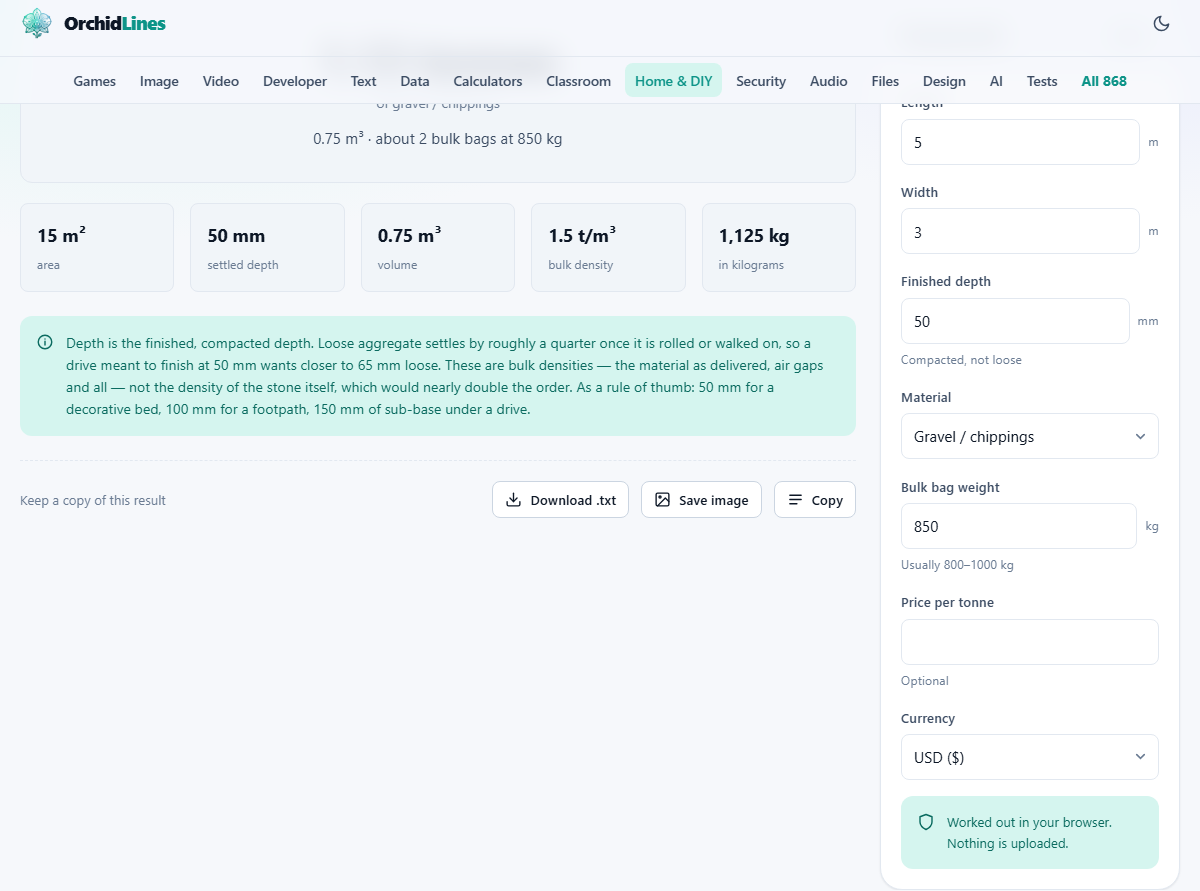
The panel is headed The area to fill. Length and Width are in metres and describe the rectangle you are covering. For an odd shape, split it into rectangles, run the tool once for each piece, and add the results.
Finished depth is in millimetres. This is the depth of the material once it has been compacted and settled, not the height of the loose pile as it is tipped. Loose aggregate drops by roughly a quarter once it is rolled, so a drive that must finish at 50 mm wants about 65 mm tipped.
Material is a dropdown with eight choices: Gravel or chippings, MOT type 1 sub-base, Sharp sand, Ballast, Topsoil, Bark or wood chip, Slate chippings, and Cobbles. Each carries its own bulk density, which is the number that turns the volume into a weight.
Bulk bag weight sets the weight of one bulk bag in kilograms. Most builder's bags hold between 800 and 1000 kg. The default is 850. If the weight is printed on the bag, put that figure in for an accurate bag count.
Price per tonne and Currency are optional. Fill them in and the result includes a cost.
What comes back
The result shows the total weight in tonnes, the total volume in cubic metres, the number of bulk bags rounded up, and the cost if you gave a price. It also repeats the area and the depth so you can check the inputs at a glance.
Both tonnes and cubic metres are given because different suppliers quote in different units. Stone is almost always sold by weight. Bark and wood chip are usually sold by volume. Having both figures lets you compare two quotes on the same basis without doing the conversion yourself.
The bag count always rounds up to a whole number. A builder's bulk bag usually holds between 800 and 1000 kg, and the exact weight is printed on the side. Setting the Bulk bag weight field to match your supplier's bags makes the count accurate enough to order by.
A worked example: gravelling a front drive
The drive is 5 metres long and 3 metres wide. The finished depth is 50 mm. The material is gravel and chippings.
The area is 5 times 3, which is 15 square metres. The depth is 50 mm, which is 0.05 metres. Multiply those together and the volume is 0.75 cubic metres. Gravel has a bulk density of about 1.5 tonnes per cubic metre, so the weight is 0.75 times 1.5, which is 1.125 tonnes.
With the bag weight set at 850 kg, that works out to about 1.3 bags. You would order two bags. The tool rounds the bag count up because you cannot order a fraction of a bag, and running short on the last corner costs a second delivery charge that wipes out any saving from ordering less.
Now change the material to bark. The same 0.75 cubic metres weighs only about 0.26 tonnes because bark is so much lighter. The bag count drops as well. That is why the material choice matters so much.
Common depths for common jobs
Getting the depth right is the single biggest factor in ordering accurately. Too shallow and the ground shows through within a season. Too deep and you waste material and money. The figures below are for the finished, compacted layer. If you are tipping loose material and then rolling it, add roughly a quarter to allow for settlement.
- A decorative gravel bed over membrane: 40 to 50 mm.
- A garden path on membrane: 75 to 100 mm.
- A gravel drive on compacted sub-base: 50 mm of gravel on top of 150 mm of MOT type 1.
- A bark mulch around plants: 50 to 75 mm.
- A topsoil layer for turfing: 100 to 150 mm.
- A sub-base under a patio: 100 to 150 mm of MOT type 1, compacted.
Mistakes that cost a second delivery
Most ordering errors come from the same handful of habits. Each one is small on its own, but any of them can leave you a bag short or a tonne over.
- Using loose depth instead of finished depth. A pile of gravel tipped onto a drive settles by about a quarter once walked on or rolled. If you enter the loose figure, the order comes in short.
- Forgetting the sub-base layer. A gravel drive that goes straight onto soil sinks into the ground within a year. The sub-base is a separate order and needs its own calculation.
- Treating bark like stone. Bark is sold by volume, not weight, because it is mostly air. Ordering it in tonnes can confuse the supplier and the price.
- Mixing up solid density and bulk density. Using 2.7 for granite instead of 1.5 would double the order.
- Not rounding up the bag count. Half a bag left over costs you almost nothing. Half a bag short costs you an entire delivery.
Wet material and weather
The densities used here are typical delivered figures for dry or slightly damp material. Rain changes them. A rained-on load of sand or topsoil can weigh ten per cent more than the same volume of dry material. That means a delivery ordered by weight might look smaller in volume than you expected, even though the correct tonnage arrived.
If you are ordering in winter or during a wet spell, mention it to the supplier. Some yards weigh the load on a weighbridge, so you pay for the water as well as the stone. Others quote a fixed bag weight and the extra moisture is free. Knowing which system your supplier uses saves an argument when the load arrives.
When a different tool covers the job better
This tool handles bulk materials by area and depth. Other jobs on the same project may need a different page.
- For working out the studs and plasterboard in a partition wall, the Stud Wall and Framing Calculator counts every piece of timber.
- For choosing insulation to go inside a wall or a roof, the Insulation and Heat Loss Calculator shows how different materials compare.
- For sizing a heater or an air conditioner, the Air Conditioner and Heater Sizing page works from the room and the building.
- For seed and fertiliser on a new lawn laid over the topsoil, the Lawn Seed and Fertiliser Calculator takes the area and the grass type.
Your measurements stay with you
The whole calculation runs in your browser. The length, width, depth and material you enter are not sent anywhere. There is no server involved, no login, and no record of your job kept after you leave. You could turn off your internet connection and the page would still give the same answer, because the arithmetic never needed a connection in the first place.