
Predicting how far a loaded shelf will bend
Why span matters more than thickness, what the stiffness numbers in the material list mean, how a glued-on lip can outperform a thicker board, and what creep does to chipboard over the years.
The physics in one sentence
A shelf is a beam. Load it and it bends. How far it bends depends on four things: how far apart the supports are, how thick the board is, how stiff the material is, and how heavy the load is.
The catch is that these four things do not carry equal weight. The span between the supports controls the result far more than anything else, because deflection follows the fourth power of the span. Double the span and the sag goes up sixteen times. Halve it and the sag drops to a sixteenth. No other change you can make comes anywhere close.
Thickness comes next in importance. Stiffness follows the cube of the thickness, so going from 18 millimetres to 25 millimetres cuts the deflection by nearly two thirds. But adding one bracket in the middle of a long span beats any realistic increase in board thickness.
What counts as too much
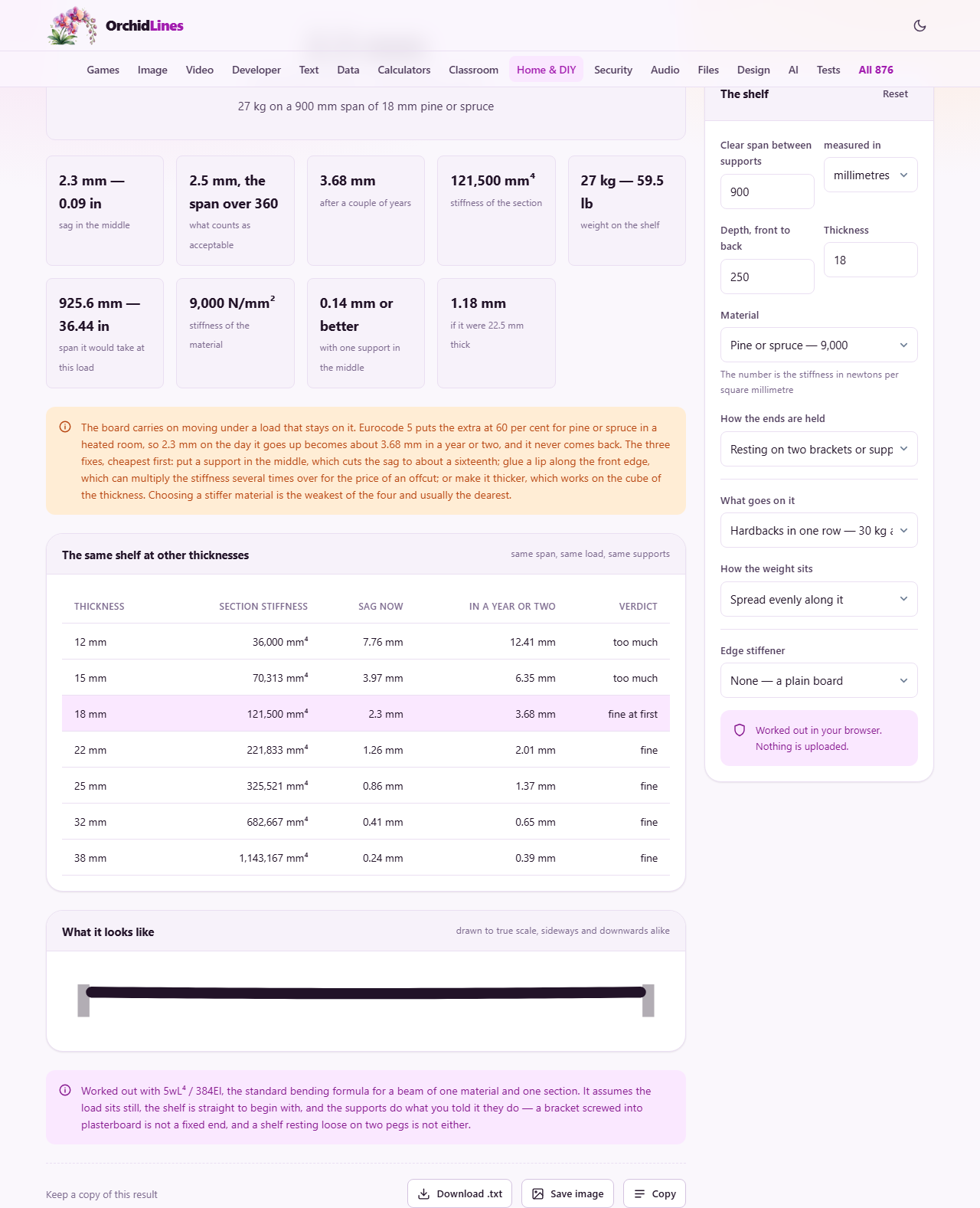
The standard limit is the span divided by 360. On a 900 millimetre shelf that is about 2.5 millimetres. Below that figure the eye reads the shelf as straight. Above it the curve becomes visible, especially when there is a level line nearby, like a window frame or a skirting board.
This has nothing to do with the shelf breaking. A board can sag badly and still hold the weight without failing. The limit is about looks, not strength. The tool uses the span-over-360 rule and tells you whether your shelf passes or fails it.
A cantilever, a shelf held at one end only, is judged more strictly. Because it sticks out into the room with nothing at the far end, the eye notices the droop more easily. The tool treats its projection as if it were twice as long for the purposes of the check.
Filling in the controls
Clear span between supports is the gap between the two brackets or the two walls, not the overall length of the board. If the board overhangs the brackets at each end, the bending happens over the gap between them, not the full length.
Depth is the front-to-back measurement. Thickness is the top-to-bottom measurement of the board. The length unit can be switched between millimetres, centimetres, metres and inches.
The material list shows a stiffness number beside each name. That number is the modulus of elasticity in newtons per square millimetre. A higher number means a stiffer material. Pine sits at 9,000 while steel is at 200,000. If your board is not on the list, choose Something else and type in the value from the data sheet.
How the ends are held offers three settings. Resting on two brackets is the most common. Built in solidly at both ends is for a shelf housed in grooves in the side panels. Held at one end only is a floating shelf bolted to the wall with no visible support at the front.
Describing the load
The contents list gives weight per metre of shelf for common items. Hardbacks in one row weigh about 30 kilograms a metre. Vinyl records standing up are heavier at 55. Ornaments and photos are the lightest at 8.
If you know the total weight, choose A weight I will type in and enter it in kilograms or pounds. The tool also asks how the weight sits. Spread evenly along it is the usual case. All in one place in the middle is worse, because a concentrated load in the centre makes the beam bend more than the same weight spread out.
A shelf that holds a heavy piece of equipment in the middle, like a microwave or a printer, should use the point load setting. The deflection from a centred point load is about 60 per cent more than the same weight spread evenly.
Materials and what the numbers mean
Chipboard is the softest board material on the list at 2,750. MDF is slightly stiffer at 3,600, but both are far below solid timber. Pine and spruce sit at 9,000, and hardwoods like oak and maple are in the 12,000 to 13,000 range.
Glass and aluminium are close to each other at around 70,000, which makes glass shelves surprisingly stiff. Steel is the stiffest at 200,000, but it is heavy and not common in domestic shelving.
Plywood has a catch. The stiffness depends on the grain direction. A sheet is roughly three times stiffer along the face grain than across it. The figure on the list is for the stiff direction, so always cut the shelf with the face grain running along the span. Rotate it the wrong way and the sag will be roughly three times what the calculator predicts.
Toughened glass is worth a note. Toughening makes glass much harder to break, but it does not change its stiffness. A toughened glass shelf sags exactly as far as a plain one of the same thickness.
What a front lip does and why it works
The edge stiffener option lets you add a lip glued under the front edge, the back edge, or both. A lip is a strip of wood hanging below the board, and it makes the shelf dramatically stiffer.
The reason is geometry. Stiffness depends on how the material is arranged around the middle of the cross section. A flat board puts all its material near the centre, where it contributes least. A lip moves material further from the centre, where it does far more work.
A 40 millimetre lip on an 18 millimetre pine shelf can make it roughly six times stiffer. That is better than doubling the thickness, and it costs only an offcut and some glue. The lip must be properly bonded, though. A lip that is only pinned or tacked and can slide on the joint does nothing at all, because it acts as a separate piece rather than part of the section.
Creep and why chipboard keeps sagging
Wood-based boards creep under a load that stays on them. Creep is the slow, ongoing deflection that happens even though the load has not changed. It is worst in chipboard and MDF, and it never reverses. Take the books off after two years and the bow remains.
Eurocode 5 puts the creep factor for chipboard in a heated room at more than double the initial deflection. That means the sag you measure on the first day is roughly a third of the sag you will see after a year or two. The tool shows this long-term figure alongside the immediate one.
Solid timber creeps too, but far less. Hardwoods are the most stable. If a shelf will carry a permanent load for years, the material choice matters as much as the thickness.
A worked example
An 18 millimetre pine shelf spans 900 millimetres between two brackets. It holds a row of hardbacks at 30 kilograms per metre, spread evenly. The tool reports immediate deflection well within the limit and shows the shelf passes the span-over-360 check.
Widen the span to 1,200 millimetres and the result changes sharply. The sag more than triples because deflection follows the fourth power of the span. The same shelf now fails the check.
Go back to 900 and switch the material to chipboard. The initial sag is higher, and the two-year creep figure pushes the total well past the limit. Adding a 40 millimetre lip under the front edge brings it back, showing that a simple strip of wood can rescue a weak board.
Practical fixes when a shelf already bows
- Add a support in the middle. Cutting the span in half drops the sag to a sixteenth.
- Glue a hardwood lip along the front edge. It is the cheapest structural improvement.
- Replace the board with a stiffer material. Birch plywood at 10,300 is nearly four times stiffer than chipboard.
- Move the brackets closer together. Even 100 millimetres less span makes a visible difference.
- Flip the board. A shelf that has crept into a permanent curve will not flatten, but turning it upside down puts the crown at the top, where gravity works to level it under the load.
All the arithmetic runs locally
Every calculation happens inside your browser. Your shelf dimensions, the material and the load never leave your device. There is no sign-up, no server, and nothing to clear afterwards.