
Finding the volume so the chemistry lands right
Why pool chemicals are dosed per unit of water, how to measure and calculate the volume for rectangular, round and oval pools with sloping floors, and what the dosing figures mean in practice.
Every dose starts with the volume
Chlorine, stabiliser, salt, alkalinity increaser -- every pool chemical is measured in parts per million, and parts per million means a weight of chemical per volume of water. Get the volume wrong and every dose is wrong by the same fraction, all season long.
A pool that is actually 40 cubic metres but entered as 50 will be under-dosed by a fifth on every treatment. The chlorine never quite holds, algae creeps in, and the owner blames the product. The fix is not more chlorine. The fix is a better volume number.
This calculator works out the volume from the shape you pick and the measurements you give, then converts a pair of test-kit readings into an amount of product to add.
Measuring the pool
Shape offers rectangular, round and oval. Most garden pools are rectangular. An oval pool is a rectangle with rounded ends.
Length or diameter is the longest measurement across the water surface. For a rectangular pool that is the length. For a round pool it is the diameter. Width is the shorter measurement for a rectangular or oval pool. It is not needed for a round pool.
Measure at the waterline, not at the top of the coping. The tiles and the coping above the water surface hold no water, and including them will overstate the volume. Similarly, the box volume printed on an above-ground pool kit is usually the volume to the rim. In practice the water sits 100 to 150 millimetres below that so the skimmer can work, which can easily be five per cent of the total.
Shallow end and deep end
Two depth boxes appear: Shallow end depth and Deep end depth. For a pool with a flat floor, put the same number in both. For a pool that slopes from a shallow end to a deep end, put the depth at each end.
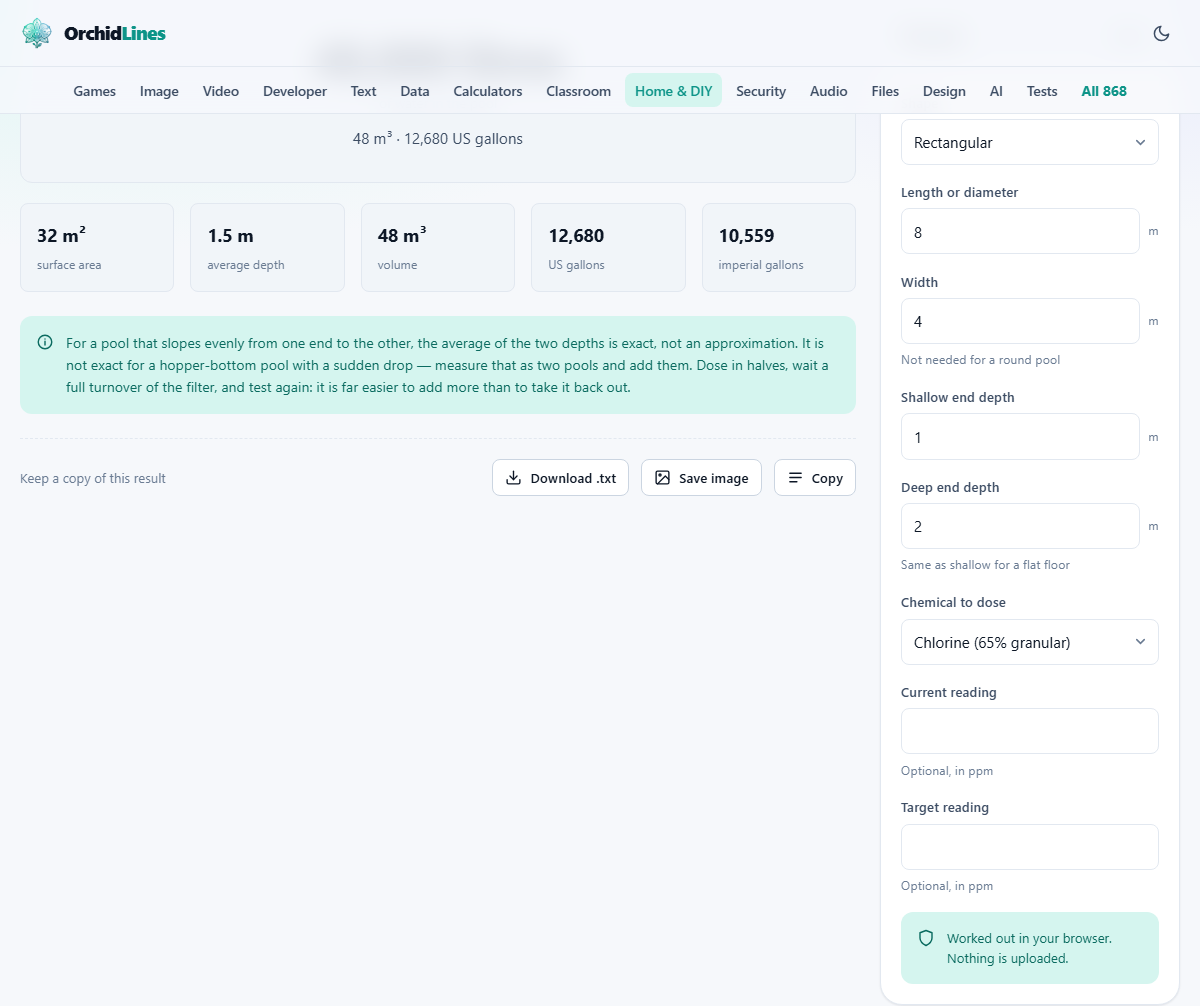
The calculator takes the average of the two, which is exact for a floor that slopes at a constant angle end to end. Most residential pools slope evenly, so this is the right method for them.
A hopper bottom is different. If the floor is flat at the shallow end, drops away steeply into a diving well, and then is flat again at the deep end, the average overstates the volume. For that kind of floor, treat the shallow section and the deep section as two separate pools, add their volumes, and use the combined figure for dosing.
Understanding the volume output
The result shows the volume in litres, US gallons and imperial gallons. This three-way display matters because American dosing charts use US gallons, British ones use imperial gallons, and the metric world uses litres or cubic metres.
US gallons are about twenty per cent smaller than imperial ones. Confusing the two is easy and common. It results in over-dosing by a fifth if you read a US chart and apply it to imperial gallons, or under-dosing by the same fraction the other way round. Seeing all three numbers side by side is the simplest guard against the mistake.
Choosing a chemical and entering readings
Chemical to dose offers four products: chlorine as 65% granular, stabiliser as cyanuric acid, alkalinity increaser, and pool salt. These cover the chemicals that are dosed by weight per volume.
Current reading is what your test kit says now, in parts per million. Target reading is where you want to be. Both are optional. Without them the calculator shows only the volume. With them it shows the amount of product to add.
For chlorine the typical target is between 1 and 3 ppm. For stabiliser it is 30 to 50. For alkalinity it is 80 to 120. For salt it depends on the generator, but most want 3000 to 4000 ppm. The ranges differ between brands and countries, so the figure on the label of the product you actually own is the one to follow.
Why you should dose in halves
Add half the suggested amount, run a full turnover through the filter, and test again. There are two good reasons for this.
First, the volume is an estimate. It might be a few per cent off, and the concentration of the product might vary from batch to batch. Dosing in halves means the first addition lands close and the second addition trims it to the target.
Second, almost nothing in pool chemistry can be undone. If chlorine is too high, you wait for it to come down on its own or dilute by draining water and refilling. If stabiliser is too high, the only cure is to drain some of the pool and refill with fresh water. Adding in halves is far cheaper than draining.
A worked example with real numbers
A rectangular pool is 8 metres long and 4 metres wide. The shallow end is 1 metre deep and the deep end is 2 metres. The average depth is 1.5 metres. The volume is 8 times 4 times 1.5, which is 48 cubic metres, or 48,000 litres.
A test kit shows free chlorine at 0.5 ppm. The target is 2 ppm, so the gap is 1.5 ppm. The calculator works out the weight of 65% granular chlorine needed to raise 48,000 litres by 1.5 ppm. Adding half of that, running the pump for a full turnover, and testing again will show whether a second half is needed or whether the reading has already landed close enough.
Above-ground pools
An above-ground pool works exactly the same way. The floor is almost always flat, so put the same depth in both boxes. Measure the depth of the water, not the height of the wall. The wall sticks up above the water level, and including that height would overstate the volume.
Round above-ground pools are common. Pick the round shape, type in the diameter, and put the water depth in both depth fields. Oval above-ground pools use the oval shape. A typical 12-foot round pool that is 3 feet deep holds roughly 7,600 litres. That is much less water than it looks like from the outside, and the chemical doses are smaller to match.
Lowering a reading that went too high
There is no chemical that lowers most readings. Chlorine comes down on its own if you leave the cover off and the sun breaks it down, but that takes days. Stabiliser and salt only come down by dilution.
Dilution means draining some water and adding fresh. If the reading is 20 per cent too high, drain and refill roughly a fifth of the pool. Test again, because the fresh water mixes gradually and the first test after refilling can be misleading.
This is the practical reason why adding in halves matters. Removing a chemical costs water, time and money. Adding more costs only the product.
The label always wins
Product strengths differ between brands and between countries. The dosing figures here are for typical products. If the tub in your shed says something different, follow the tub. A 65% calcium hypochlorite granule and a 55% one need different weights to reach the same ppm, and the label is the only place that tells you which you have.
For liquid chlorine the strength is usually printed as a percentage of available chlorine by weight. It is lower than granular, so the dose in millilitres is higher. The calculator uses the granular figure, so if you are dosing with liquid you will need to convert.
Salt generators also vary. Some want 2500 ppm, others want 4500. The manual for the unit tells you the range. Too little salt and the generator cannot produce enough chlorine. Too much and it shortens the life of the cell. The target reading you type in should come from your generator's manual, not from a general guide.
Seasonal opening and closing
When opening a pool after winter, the volume has not changed, but the chemistry has drifted. Test everything before you add anything. The stabiliser is probably still close to where it was. The chlorine is probably zero. The alkalinity may have shifted if rainwater got in.
Start by getting the alkalinity right, then the stabiliser, then the chlorine. Doing them in that order matters because alkalinity affects how stable the chlorine reading stays, and stabiliser protects the chlorine from sunlight. Adding chlorine first is wasted effort if the stabiliser is too low to keep it there.
Your readings stay private
The volume and dosing sums run entirely in your browser. No pool measurements, no chemical readings, and no personal details leave your device. There is no server involved and no account to create. Close the tab and everything is gone.