
Counting plants before you buy them
How to work out how many plants fill a bed at a given spacing, why offsetting alternate rows fits more without crowding, and how to read the row-by-row plan so you can mark it out on the ground.
What plant spacing actually means
Spacing is measured from the centre of one plant to the centre of the next. Not from the edge of one pot to the edge of the next, and not the gap between the leaves. Every nursery label, every gardening book, and every seed packet means centre to centre when it gives a spacing figure.
This matters because plants grow. A lavender in a nine centimetre pot is a fraction of its final size. Planting it at the pot width would give you a wall of lavender by the second summer, and half of it would have to come out. The label says 45 centimetres because that is the mature spread, and one season of bare soil is the price of a bed that looks right for a decade.
The quick rule for how many plants fit a square metre is one divided by the spacing in metres, squared. At 30 centimetres, that is one divided by 0.09, which is about 11. At 20 centimetres it jumps to 25. The calculator does this for the whole bed, but the per-square-metre figure is handy when comparing prices at the garden centre.
Picking the bed shape
Shape offers three options. A rectangular bed or border is the most common and takes a Length and a Width. A round bed takes a single measurement, Across the middle, which is its diameter. A single row is for hedging or edging and only needs a length.
The bed is measured in lets you work in metres, centimetres, feet or inches. The results come back in the same unit. The spacing can be in a different unit from the bed, which is useful when a nursery gives spacing in centimetres but you measured the border in metres.
Setting the spacing yourself or choosing a plant
Plant offers a list of common plants and vegetables with their standard spacings already filled in. Choosing one does not lock the numbers in. It fills the two spacing boxes with sensible starting values, and you can change them if you want to plant tighter or wider.
Spacing along the row is the gap between plants in the same line. Spacing between rows is the gap from one line of plants to the next. For flowers and ground cover the two are usually the same. For vegetables the row spacing is wider because somebody has to walk between the rows, or a hoe has to fit.
If you leave Spacing between rows empty, the calculator fills it in on its own. For offset rows it uses the spacing times 0.866, which is the exact figure that keeps every plant the same distance from all six of its neighbours. For a square grid it uses the same spacing as along the row.
Square grid or offset rows
Show me gives you two choices. A square grid puts every plant directly behind the one in front. It is easy to set out and easy to hoe, and it is the natural layout for vegetables in straight drills.
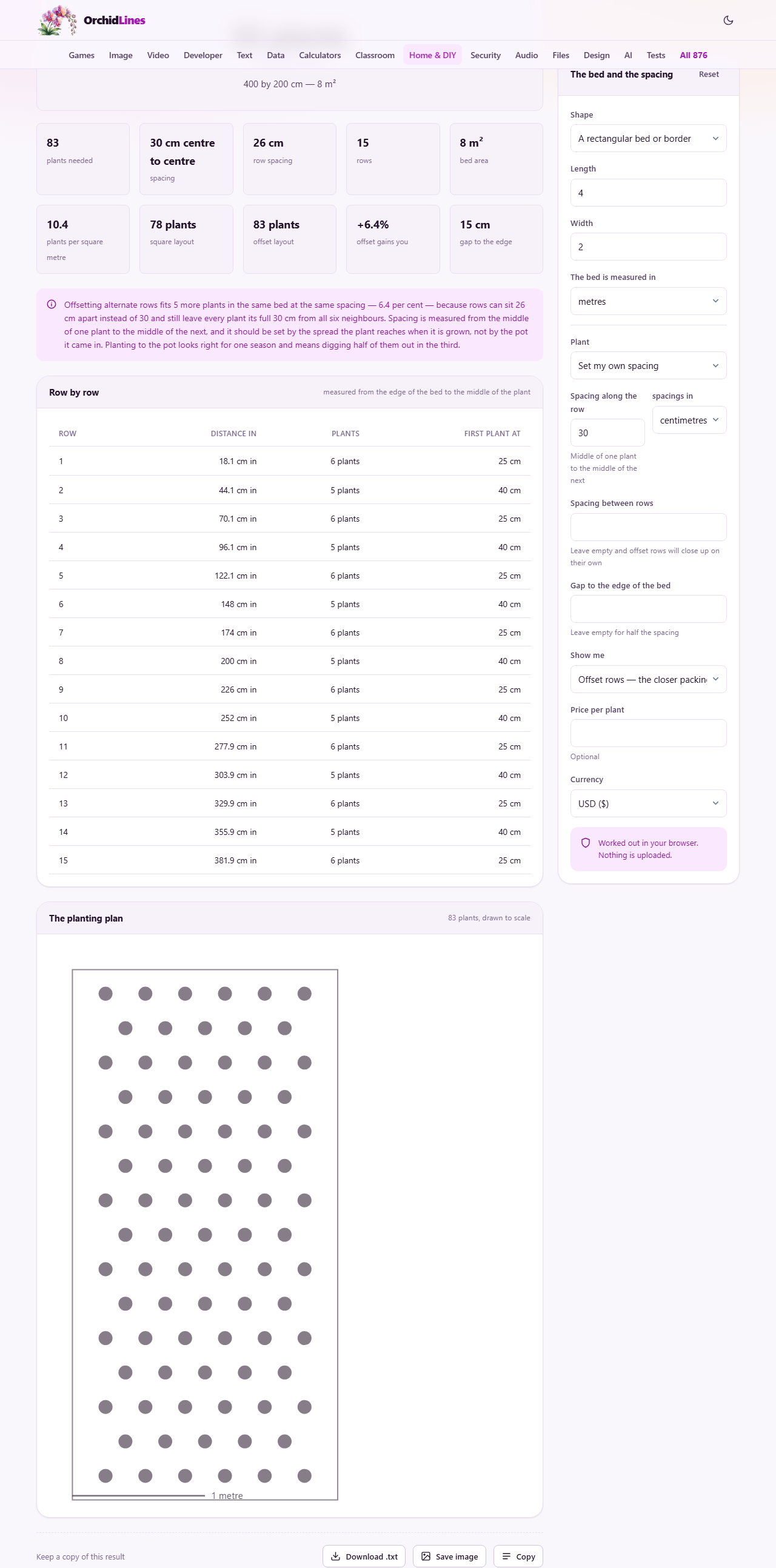
Offset rows shift alternate lines sideways by half a spacing. The rows then sit closer together while every plant still keeps its full distance from all its neighbours. The result is about fifteen per cent more plants in the same area, without any crowding. For flowers, ground cover, and anything ornamental, offset rows are almost always the better choice.
The plan view drawn to scale shows the difference clearly. Dots on a square grid leave diamond-shaped gaps. Dots on an offset grid sit in a honeycomb, and the gaps between them are smaller and more even.
The edge gap and why it matters
Gap to the edge of the bed sets how far the outermost plants sit from the boundary. Leave it empty and the calculator uses half the spacing, which is the standard rule. The front row then has enough room to grow to full spread without flopping over the lawn or the path.
Set it to zero and the plants go right up to the edge. This works for a raised bed where the wall contains them, but in a ground-level border it means the mower clips the front row every week. A gap of half the spacing is cheap insurance.
Reading the row-by-row list
Below the plan view the calculator prints a list of every row. Each line tells you the row number, how far in from the edge of the bed it sits, how many plants are in it, and where the first plant goes. The offset rows will have one fewer plant than the rows next to them, because the sideways shift pushes the end plants past the boundary.
On the ground, lay a string line across the bed at the distance the first row says. Measure along it for the first plant position, then step off the spacing for each plant after that. Move the string to the next row and repeat. A tape and a line are all the tools you need.
For a circular bed the row list also shows the width of each row, because the rows near the edge of the circle are shorter than the ones through the middle. The plan drawing makes this visible at a glance. Each row has fewer plants as it gets closer to the rim, and the total is less than you would get from the same area in a rectangle.
Hedging and single rows
Switch Shape to A single row for a hedge, an edging, or a line of beans up a fence. The calculator gives you the total number of plants and the rate per metre.
Nurseries sometimes quote hedging as plants per metre rather than a spacing. Five per metre is 20 centimetres apart. Three per metre is about 33. It is the same number said the other way round, and it is where ordering mistakes happen. Someone reads five per metre as five metres of hedge plants and ends up with a fraction of what they need. Work out the spacing you want, count the row length, and order against the total.
Vegetables and their wider rows
The plant presets for vegetables include both the in-row spacing and the row spacing. Onions at 10 centimetres apart in rows 30 centimetres apart. Potatoes at 35 in rows 75. Tomatoes at 45 in rows 90. The wider row gap is not optional. It is the space a hoe or a pair of knees needs to work between the plants without damaging them.
Sweetcorn is a special case. It is wind pollinated, so the pollen blows from one tassel to the silks of the next. A single long row looks neat but sets almost no cobs, because the wind carries the pollen past the only plant that could catch it. Plant sweetcorn in a block of at least four rows, no matter how narrow the bed.
Cost and how many to order
Price per plant is optional. Fill it in and the calculator shows the total cost for the bed. This is useful when comparing plug plants at one price against larger pots at another, or when a nursery offers a discount for orders above a certain quantity.
Always order a few more than the total says. Some will die in the first week, especially plugs planted in a dry spell. Five to ten per cent extra is a sensible buffer. For bedding plants sold in trays of six or twelve, round up to whole trays and treat the leftovers as spares.
A worked example for a border
A rectangular border is 4 metres long and 1.2 metres wide. The plant is ground-cover geranium at 30 centimetre spacing. Bed units are metres, spacing units are centimetres.
On a square grid the calculator shows about 52 plants in four rows. Switch to offset rows and it fits 60 in five rows at the same spacing. The extra row appears because the offset rows sit closer together, so one more fits across the 1.2 metre width. The cost difference at a pound a plant is eight pounds, and the border fills in one season sooner.
All of this stays on your own device
The spacing sums and the plan drawing are all done by your browser, on your own machine. Nothing you type is sent anywhere. There is no account to create, no data stored on a server, and no reason to worry about what happens to your garden measurements after you close the page.