
Buying the right number of tins, not litres
How to measure a room, account for doors and windows, handle bare plaster that soaks up far more than the label says, and turn the answer into a tin count you can actually buy at the shop.
Why the tin never goes as far as it claims
Every tin of emulsion prints a coverage figure on its label. It is usually ten to twelve square metres per litre for walls. That number is real, but it comes with a long footnote: one coat, on a smooth, sealed, mid-coloured surface, applied with a roller by somebody who knows what they are doing.
In a real room the figure drops. Textured walls have more surface area per square metre. Dark colours need thicker coats to hide what is underneath. Brushwork lays the paint on less evenly than a roller. And bare plaster drinks the first coat almost entirely, so it barely counts as covering at all.
The calculator takes the number on the tin as a starting point and then adjusts for the surface you tell it about. It does not guess at the coverage. You read the figure off the tin and type it into the Coverage on the tin box, and the sums use that figure for the sealed, best-case coat.
Measuring the room
Two numbers describe the walls: the total length all the way round, and the height. The length goes into Wall length to paint, in metres. Start in one corner and add up every wall, including the one with the door in it. The doors and windows are handled separately, so do not skip a wall because it has a large window.
Wall height is floor to ceiling. In most houses that is somewhere between 2.3 and 2.5 metres. If a room has a sloped ceiling, use the average height rather than the tallest point.
If you also want the ceiling done, tick Paint the ceiling too and fill in Room width and Room length. The ceiling is a flat rectangle, so it needs its own pair of measurements rather than using the perimeter.
Taking off doors and windows
A standard door is taken off at 1.98 by 0.76 metres, and a standard window at 1.2 by 1.2 metres. Those are close enough for most houses. Two doors and two windows come to about six square metres, which is most of a litre over two coats.
Type the number of each into Doors and Windows. If you have a very large picture window or a set of double doors, measure them yourself, work out the area, and reduce the perimeter length to account for it. The calculator uses fixed sizes because they suit the majority of rooms without asking for extra measuring.
Choosing the surface type
What you are painting on to offers three choices. Painted before, or sealed is the normal case. The existing paint or a coat of primer has sealed the surface, and the coverage figure on the tin applies as printed.
New plaster needs a mist coat. This is emulsion thinned roughly one part water to four parts paint. The plaster absorbs it, and the dried coat gives the top coats something to grip. Without it the finish peels off in sheets months later. The calculator adds a full extra coat at a lower coverage rate to account for the mist coat. Mixing the mist coat is simple: pour a litre of paint into a bucket, add about 250 millilitres of clean water, and stir until it is the consistency of single cream. It goes on thin and dries quickly.
Covering a much darker colour adds a coat. Going from deep navy to white takes at least three top coats, sometimes four. Selecting this option bumps the coat count by one. The same applies in reverse, though going from light to dark is easier because the new colour has more pigment to hide what is underneath.
Coats, tin sizes and cost
Top coats defaults to two, which is right for almost every job. One coat is rarely enough to look even. Three is what dark-to-light colour changes need. Four is unusual but there if you want it.
Tin size lets you pick from 1, 2.5, 5 or 10 litres. Five is the standard for walls. The calculator rounds up to whole tins, because you cannot buy 6.3 litres. That rounding means you will usually have some left over, which is a good thing. Paint keeps for years in a sealed tin and is the only way to touch up a scuff with an exact match later.
Price per tin is optional. Fill it in and the total cost appears alongside the tin count. Currency picks the symbol.
A worked example from start to finish
A bedroom measures 4 metres by 3.5 metres. The perimeter is 4 plus 3.5 plus 4 plus 3.5, which is 15 metres. The ceiling height is 2.4 metres. There is one door and one window. The walls were last painted magnolia and are getting a fresh coat of the same.
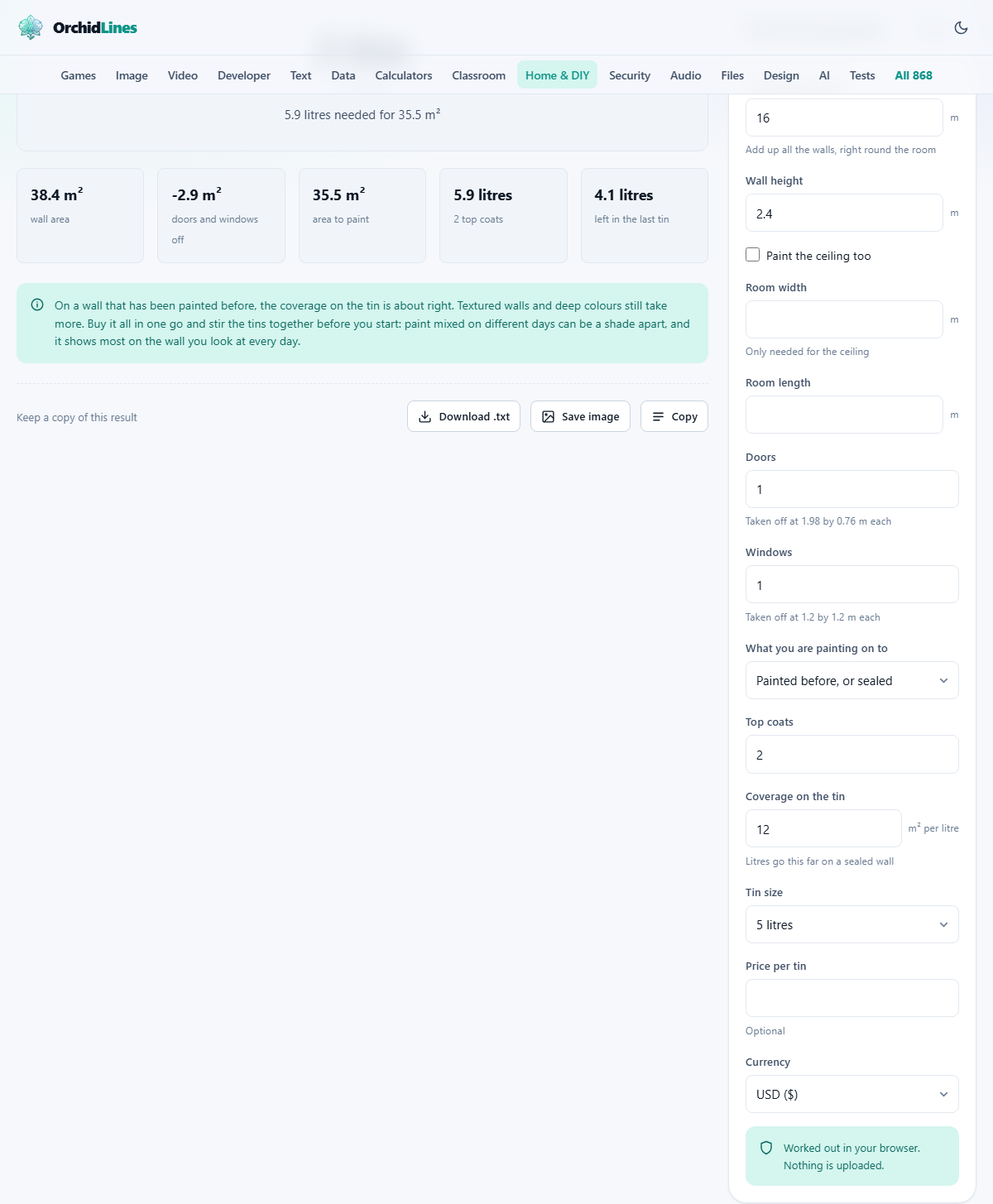
Wall length to paint: 15. Wall height: 2.4. Doors: 1. Windows: 1. Surface: Painted before, or sealed. Top coats: 2. Coverage on the tin: 12. Tin size: 5 litres.
The gross wall area is 36 square metres. After the door and the window come off, the net area drops to about 33.1. Two coats at 12 square metres per litre is 5.5 litres. That rounds up to two 5-litre tins. The spare 4.5 litres stays in the second tin for touch-ups.
Now change the surface to new plaster. The mist coat is costed at half the tin's coverage, because bare plaster drinks it, so that one pass costs as much as both top coats together. The total jumps to about 11 litres, which needs three 5-litre tins rather than two. Switching to 2.5-litre tins would call for five of them.
Common mistakes and how to avoid them
- Measuring the slope of the ceiling instead of the flat width and length. The ceiling area is the floor area, not the rafter area.
- Forgetting to include the wall behind the door when adding up the perimeter. The door itself comes off, but the wall around it is still painted.
- Skipping the mist coat on new plaster and then wondering why the second coat is still patchy. The bare plaster absorbs the first full-strength coat unevenly.
- Buying two tins from different batches and starting one on each wall. Tins mixed on different days can vary slightly in shade. Pour them both into a bucket and stir before you begin.
- Trying to save a tin by spreading a single coat thinly. A thin coat dries streaky, and you end up doing the second coat anyway, having wasted the time on a bad first one.
How the ceiling changes the numbers
Ceilings use the same paint per square metre as walls, but they are harder to cover evenly because gravity pulls the roller dry faster. If the ceiling is textured or has old artex on it, the real coverage will be lower than the smooth-wall figure.
The calculator treats the ceiling as a separate rectangle. It does not take off a light fitting or a loft hatch, because those are too small to affect the tin count. If your ceiling has a large skylight, reduce the room length or width by the amount the skylight covers.
Ceiling paint and wall paint are often the same product, but ceilings are almost always white. If you are using different colours for walls and ceiling, run the calculator twice: once for the walls alone, and once with just the ceiling ticked. That gives you separate tin counts for each colour.
Ordering for more than one room
If every room is getting the same colour, add up the perimeters of all the rooms and run the calculator once with the combined figure. That gives a single tin count for the whole job, and buying in bulk means fewer leftover part-tins.
If each room is a different colour, run them one at a time. Write down the litre total for each before you go to the shop. A 10-litre tin is cheaper per litre than two fives, so check whether the larger size saves you money using the Price per tin field.
Nothing leaves your device
All the arithmetic runs right here in your browser. The measurements you type are not sent to any server, not stored, and not visible to anyone but you. Close the tab and they are gone. You can check by turning off your internet connection and running the calculator again. It will still work, because there is nothing on the other end.