
Buying timber by the board foot
Board feet confuse people because the name sounds like a length but it is actually a volume. This walks through the arithmetic, the controls on the page, the traps that make a timber order come out wrong, and a worked example that puts real numbers behind the formula.
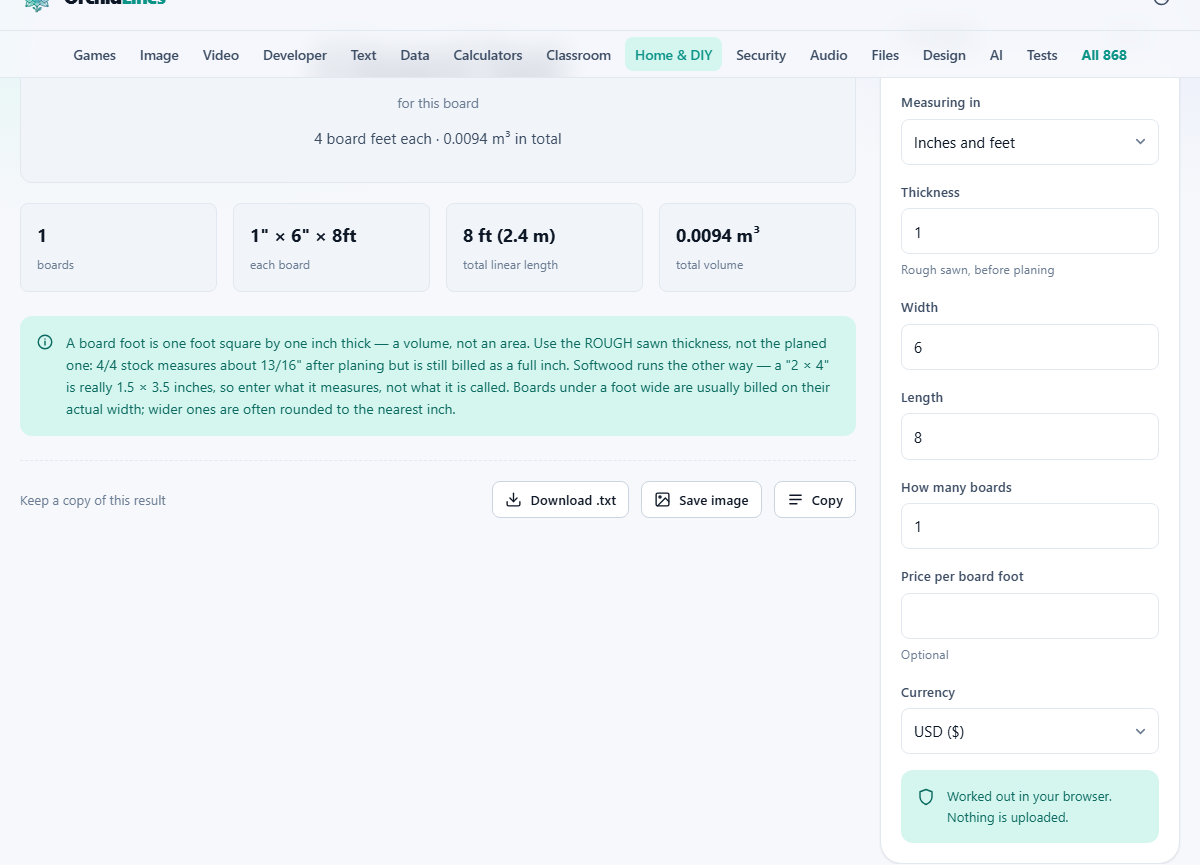
What a board foot measures
A board foot is a piece of wood one foot long, one foot wide and one inch thick. That is 144 cubic inches. It is a volume, not an area and not a length, which is why a ten foot board and a six foot board can both be one board foot depending on how wide and thick they are.
Hardwood yards price almost everything by the board foot. Softwood yards tend to sell by the linear foot at a fixed cross section, so a two by four costs per running foot and nobody mentions board feet at all. The distinction matters because the formula changes with it.
The formula written out
Multiply the thickness in inches by the width in inches by the length in feet and divide by twelve. A board that is one inch thick, six inches wide and eight feet long gives one times six times eight divided by twelve, which is four board feet.
The division by twelve is there because thickness and width are in inches but length is in feet. If all three were in inches you would divide by 144 instead, which is the number of cubic inches in one board foot.
If you work in millimetres and metres the arithmetic is different. One board foot equals roughly 0.00236 cubic metres. The calculator handles that conversion when you switch the Measuring in dropdown from inches and feet to millimetres and metres, so you never need to convert by hand.
Walking through the controls
The panel on the right is headed The timber. The first choice is Measuring in, which sets every number box to imperial or metric.
Thickness is the rough sawn figure, before any planing. The hint below the box says so, and it matters because timber is billed on what the mill sawed, not what the planer left behind. Width and Length follow in the same units.
How many boards multiplies the single-board figure into a total. If you are ordering twelve planks of the same size, type twelve there and the result gives both the per-board and the total board feet.
Price per board foot is optional. Leave it empty and you get volumes only. Fill it in and a cost line appears. Currency lets you pick the symbol that shows up on that cost line.
Why nominal sizes cause over-ordering
A softwood sold as a two by four does not measure two inches by four inches. It finishes at one and a half by three and a half after drying and planing. If you type two and four into the calculator you will get a board foot figure that is about thirty per cent higher than the real one.
Always measure what the timber actually is, not what the label calls it. This is the single biggest reason that a cut list and a quote disagree. The page itself warns about this in its tips section, and it is worth reading twice before placing a large order.
The quarter system for hardwood thickness
Hardwood thickness is written in quarters of an inch. Four quarters, written 4/4, means one inch. Five quarters is an inch and a quarter. Eight quarters is two inches. The number counts how many quarter-inch slices the mill could have taken from the plank.
When you buy 4/4 stock and have it planed, the finished board is about thirteen sixteenths of an inch, but the yard bills you for the full inch. That is normal. The mill sawed one inch of wood and it is not giving the sawdust back. Type the rough thickness into the calculator, not the planed thickness, or your board foot count will be too low and the bill will look wrong.
A worked example with real numbers
You are building a dining table top from walnut. The timber yard has 5/4 stock, which is one and a quarter inches thick. Each board is about seven inches wide and nine feet long. You need five boards.
Set Measuring in to inches and feet. Type 1.25 for Thickness, 7 for Width, 9 for Length and 5 for How many boards. One board comes out at 6.56 board feet. Five boards come out at 32.81 board feet.
The yard quotes you twelve dollars a board foot. Type 12 in the Price per board foot box and the cost reads 393.75 in your chosen currency. That is the raw timber. It does not include planing, kiln drying or any grade premium. If the invoice says more, those extras are probably why.
Cubic metres and the metric world
One board foot is about 0.00236 cubic metres. There are roughly 424 board feet in a single cubic metre. The calculator shows both figures side by side so you can compare a quote from a yard that bills in board feet with one that bills in cubic metres.
Switch Measuring in to millimetres and metres, type your dimensions in metric, and the result still gives board feet alongside cubic metres. You do not need to convert anything yourself. The two systems are just different ways of describing the same block of wood.
Adding waste to your order
Rough boards arrive with bark edges, splits at the ends and the odd knot hole. Once you straighten the edges on a jointer and cross cut the bad ends off, a board that started at nine feet might give you seven and a half feet of clear wood.
Most furniture makers add twenty to thirty per cent on top of the cut list. If the cut list says twenty five board feet, order thirty or thirty two. The waste depends on the grade of timber you are buying. Firsts and seconds lose less than number one common, but they cost more per board foot, so the saving is not as large as it looks.
Another source of waste is matching grain. Table tops and wide panels need boards that look good next to each other. You might reject two or three boards before you find ones that blend well together, and those rejected boards count against your order even though they end up in a different project.
Billing conventions that catch people out
Timber yards do not all measure the same way, and the differences add up on a large order.
- Boards narrower than twelve inches are usually billed on their true width. Wider boards are often rounded to the nearest inch, so a board that measures eleven and three quarter inches is billed as twelve.
- Some yards set a minimum charge per board, so a short offcut is billed the same as a four foot piece.
- Kiln dried stock costs more per board foot than air dried, and planed stock costs more than rough. Neither of those extras is in the raw board foot price.
- A quote given over the phone is usually an estimate. The real count happens when the boards are pulled from the stack and each one is measured.
- Exotic species like purpleheart or wenge are sometimes sold by weight rather than by volume, which sidesteps the board foot system entirely.
Weight, transport and species
A board foot of oak weighs about 3.6 kilograms when air dried. A board foot of pine is nearer two kilograms. The difference matters when you are loading a car or working out shipping costs.
If you know the volume in cubic metres from the calculator, multiply it by the density of the species to get the weight. White oak is around 770 kg per cubic metre. Eastern white pine is about 400. Cherry sits between the two at roughly 560. These are air dried figures. Green timber straight from the mill weighs considerably more because of the water still inside it.
Everything stays on your own machine
The arithmetic runs inside your browser. No dimensions, no prices and no quantities leave your device. There is no account, no login and nothing stored on a server. Close the tab and it is gone.
You can check this yourself. Open the page, turn off your internet connection, and type in your numbers. The result still appears, because there was never anything on the other end doing the work.