
Getting the seed weight and fertiliser dose right for your lawn
How to measure an irregular lawn from the shapes you can actually reach with a tape, why different grasses need such different amounts of seed, and how the three numbers on a fertiliser bag turn into grams per square metre.
What this page works out
It does two separate jobs. First, it adds up the area of a lawn from whatever shapes you can measure, subtracting the patio, the pond and the flower beds. Then it turns that area into a weight of grass seed at the correct rate for the grass you are sowing.
Second, it takes the three numbers printed on a fertiliser bag and works out how much product to spread in order to put down a target amount of nitrogen. It gives the total weight of fertiliser, the number of bags, and the cost if you enter a price.
Who reaches for this
A homeowner sowing a new lawn after a building project needs to know how many kilograms of seed to buy. A gardener overseeding a thin lawn in autumn wants the reduced rate for the different job. A groundskeeper working out a spring feed needs to know how many bags of a particular product cover the area at the right nitrogen dose. A landscaper pricing a job needs the seed and fertiliser cost before writing the quote.
The tool handles the area maths and the rate maths in one place. Without it, the lawn area means measuring the whole garden and subtracting by hand, and the fertiliser dose means reading the bag, finding a formula, and doing the division yourself.
Measuring the lawn in pieces
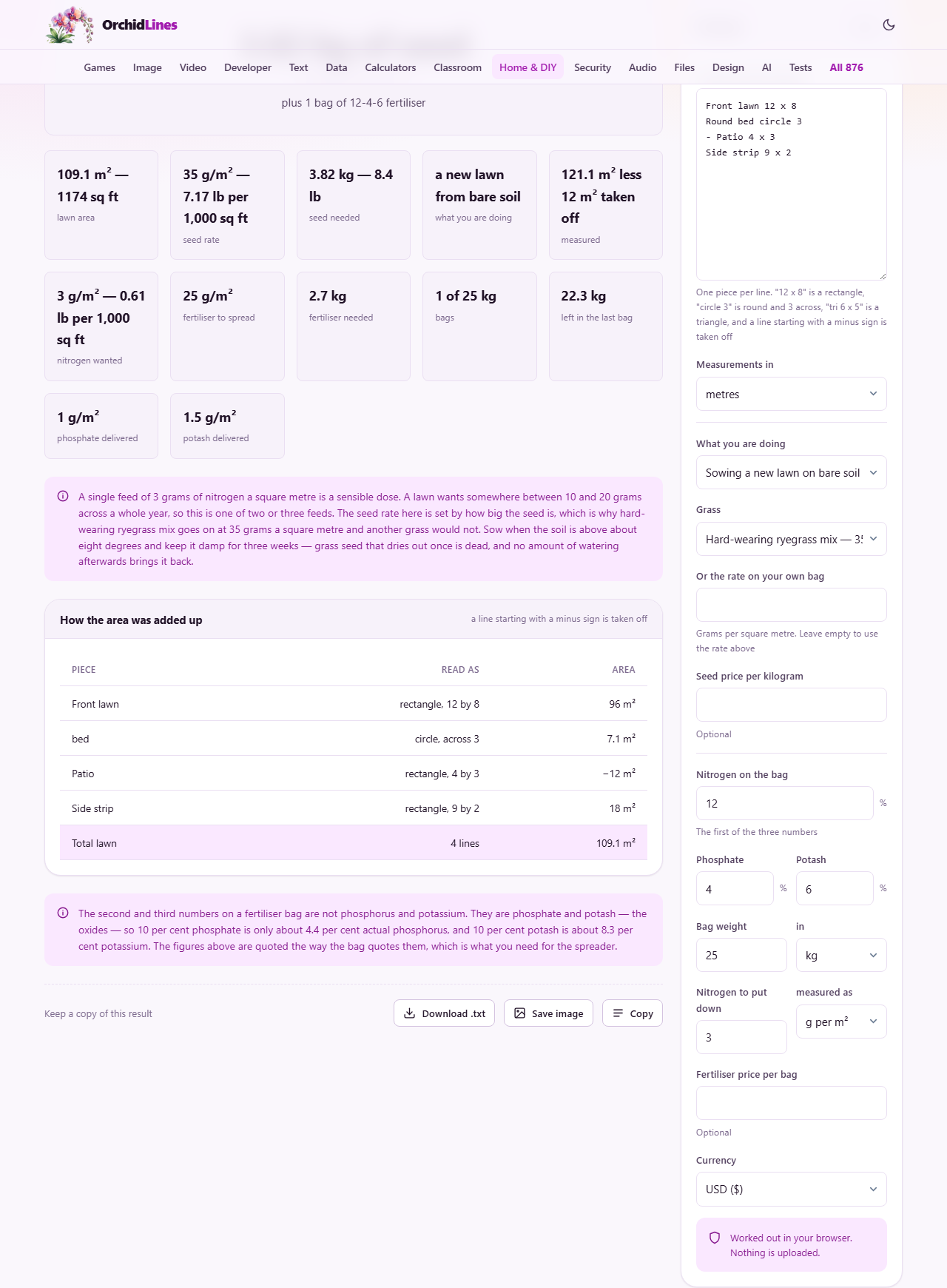
The text box headed The lawn, piece by piece takes one shape per line. A rectangle is written as its two measurements separated by an x, like 12 x 8. A circle is the word circle followed by the diameter, like circle 3 for a round bed three metres across. A triangle is tri followed by the base and the height, like tri 6 x 5.
A line that starts with a minus sign is taken off. That is how you subtract the patio, the pond, or any part of the garden that is not lawn. You can give each line a name if you want, like Front lawn 12 x 8 or Patio 4 x 3, and the name is ignored in the sum.
A dropdown below the text box lets you switch between metres and feet for all the measurements. The tool adds up the positive shapes and subtracts the negative ones to give a net area.
Choosing the grass and the seed rate
What you are doing offers three choices: sowing a new lawn on bare soil, overseeding a lawn that is already there, or patching bare spots. Overseeding uses a lower rate because the existing grass already covers most of the ground.
The Grass dropdown lists nine types, each with a default rate in grams per square metre. Hard-wearing ryegrass mix and general utility mix both use 35. Fine fescue and bent for an ornamental lawn uses 30. Shade mix uses 35. Tall fescue uses 40. Smooth-stalked meadow grass uses only 15 because its seed is far smaller. Bermuda hulled uses 8, Zoysia 10, and wildflower meadow mix just 5.
The rates differ because of seed size, not lawn quality. Ryegrass seed is large and goes on heavily. Meadow grass seed is tiny. Sowing the tiny seed at a ryegrass rate puts down about four times as many plants as the ground can hold, and they all come up thin and weak.
If your bag prints a rate that differs from the dropdown, type it into the Or the rate on your own bag field. That figure overrides the selection above. Seed price per kilogram is optional and gives a cost.
The fertiliser section
Three fields take the NPK numbers from the bag label. Nitrogen on the bag is the first number, as a percentage. Phosphate is the second. Potash is the third. These are not the same as the pure elements. Ten per cent phosphate on a bag is only about four and a half per cent actual phosphorus. The difference matters if you are matching a soil test, which usually reports the elements rather than the oxides.
Bag weight and its unit set the weight of one bag in kilograms or pounds. Nitrogen to put down is the target nitrogen dose for this application, in grams per square metre or pounds per thousand square feet. The tool divides the target by the nitrogen percentage to get the product rate, multiplies by the area, and counts the bags.
Fertiliser price per bag and Currency are optional. With them filled in, the result includes the total cost.
A worked example: seeding and feeding a new lawn
The lawn is made up of a front rectangle 12 by 8, a side strip 9 by 2, and a round bed with circle 3. The patio is 4 by 3, entered with a minus sign. Measurements are in metres.
The front lawn is 96 square metres. The side strip is 18. The round bed adds about 7.07. The patio removes 12. The net area is roughly 109 square metres.
The grass is a hard-wearing ryegrass mix at 35 grams per square metre on bare soil. The seed weight is 109 times 35, which is about 3815 grams, or 3.8 kilograms. At a seed price of 8 per kilogram that comes to about 30.50.
For the feed, the bag is 12-4-6 and weighs 25 kilograms. The target nitrogen is 3 grams per square metre. Three divided by 0.12 is 25 grams of product per square metre. Across 109 square metres that is about 2725 grams, or 2.7 kilograms. One 25-kilogram bag covers the job many times over. At a bag price of 35, the fertiliser cost for this single application is well under one bag.
Getting the nitrogen dose right
A lawn needs somewhere between 10 and 20 grams of nitrogen per square metre across the whole growing season, split into two or three feeds. A single feed should not go above about 5 grams per square metre, which is roughly a pound per thousand square feet.
Beyond that, the grass scorches. The tips go brown and the roots burn. Slow-release products are more forgiving, but even they have a limit. Two lighter feeds six weeks apart always produce a better result than one heavy one.
The tool works out one feed at a time. To plan a full season, run it once for each application and add the costs.
Timing matters more than product
Grass seed germinates when the soil temperature is above about eight degrees Celsius. A warm week in March often comes with cold ground, and seed sown into cold soil sits there and rots. The two reliable sowing windows are late spring and early autumn.
Autumn is usually the better of the two. The soil is still warm from the summer, the rain is more reliable, and there is less competition from annual weeds. The seed must stay damp from the day it goes down until it is properly up, which takes two to three weeks. If you cannot water through a dry spell, wait for the next window rather than gambling on the weather.
Spreading evenly
However carefully the rate is calculated, the finish depends on how evenly the product goes down. The habit that separates a professional result from a striped lawn is simple: set the spreader to half the rate and go over the whole area twice, with the second pass at right angles to the first. Any strip you miss on one pass is covered on the other. Any strip you double up on gets twice the half rate, which is the full rate. The worst case is the correct dose rather than a visible line.
Mistakes that show up weeks later
- Using a ryegrass rate for meadow grass. The tiny seed is smothered and every plant comes up thin and weak.
- Applying more than 5 grams of nitrogen at once. The lawn scorches and goes brown within days.
- Sowing in cold soil. A warm afternoon does not mean warm soil. Wait until the ground has held above eight degrees for a week.
- Letting the seed dry out after sowing. Once it has started to take up water, drying out kills it. Light watering twice a day beats heavy watering once a week.
- Confusing phosphate with phosphorus. The bag number is the oxide, which is about 44 per cent element. A soil test reports the element. Comparing the two directly overestimates what the bag delivers.
When another page fits the job
- For working out the topsoil or gravel needed before the lawn goes down, the Gravel, Sand and Soil Calculator gives the weight from the area and depth.
- For sizing a heater or air conditioner for the room next to the garden, the Air Conditioner and Heater Sizing page covers the whole room.
- For counting the timber in a fence or partition, the Stud Wall and Framing Calculator lists the pieces.
Your lawn plan stays private
All of the arithmetic happens on your own device, inside your browser. The shapes you type, the grass you choose, and the fertiliser numbers from your bag are never sent to a server. There is no account and no stored data. Close the tab and every figure you entered is gone. The page works offline for the same reason: the calculation has nothing to send and nowhere to send it.