
Turning window measurements into a fabric order
How the pole length, the drop, the fullness and the pattern repeat combine to give you a cutting list you can hand to a shop, and a pleat plan you can mark on the fabric.
Counting widths, then cutting to the repeat
Two sums make the metre figure. One runs across the roll and gives whole widths. The other runs down it and gives the cut length. Multiply the two and you have the order.
The across sum is the pole times the fullness, shared between the curtains, plus a side hem on each edge. Side hems start at 6 cm. The roll then loses 2 cm before anything is counted, because the selvedges are woven tighter than the rest and drag on a seam, so a 137 cm roll offers 135 cm of cloth you can use. Divide, then push up to the next whole width. Tick Half widths are allowed and it pushes up to the next half instead.
Every heading brings its own fullness and its own turn-over at the top. Leave the Fullness box empty and the heading decides:
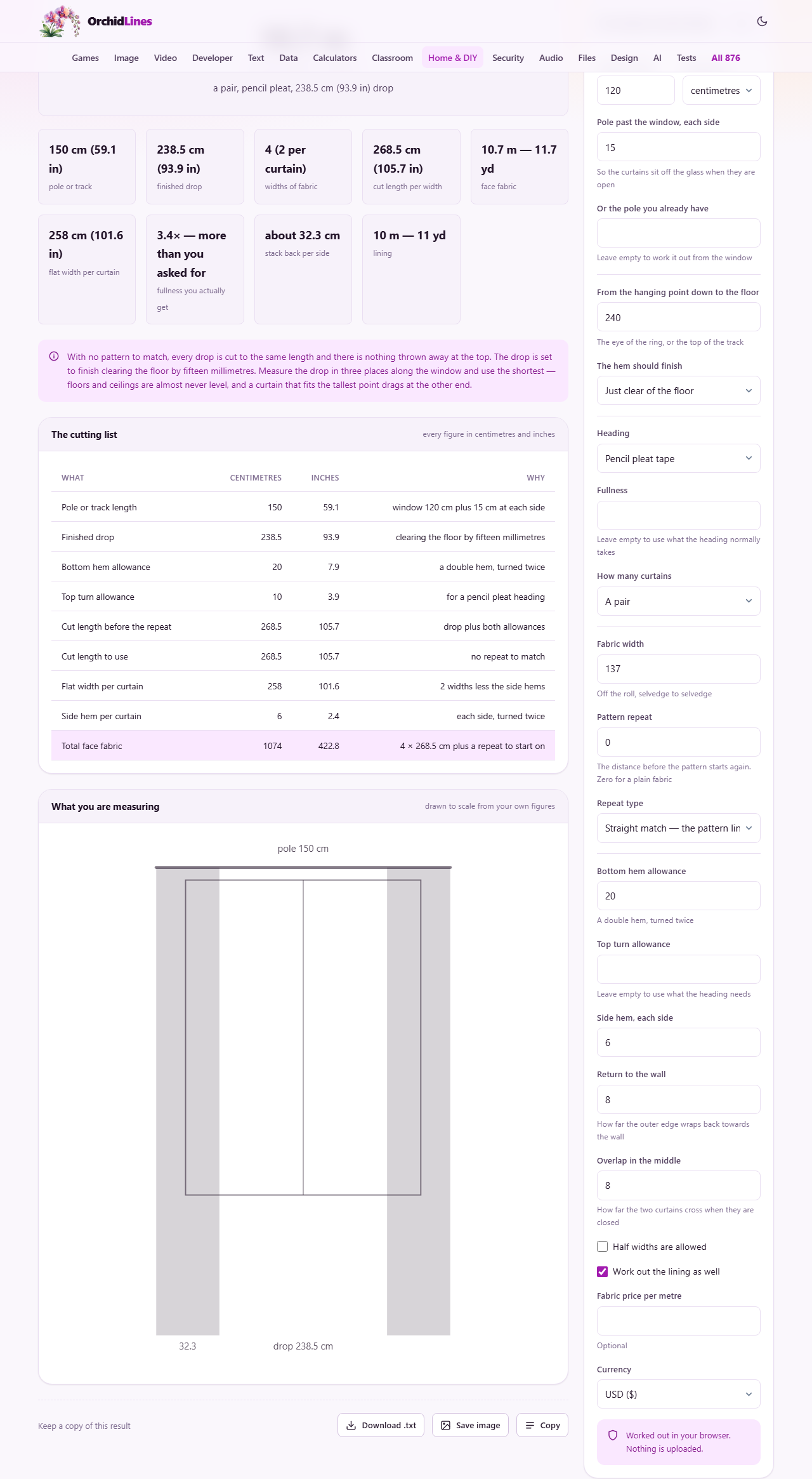
Take the figures the page opens with. A 120 cm window with 15 cm past each side gives a 150 cm pole. Pencil pleat, a pair. 150 times 2.25 is 337.5 cm of flat cloth for the two of them. Half of that is 168.75 cm, and 12 cm of side hems makes 180.75 cm per curtain. Divided by 135 that is 1.34 widths, which goes up to 2. Four widths for the pair.
Rounding up is not free, and the tool shows you the bill. Two widths give 270 cm, less 12 cm of hems, so 258 cm of flat cloth per curtain. Across the pair that is 516 cm hanging on a 150 cm pole, which is 3.4 times fullness rather than the 2.25 you asked for. A line called fullness you actually get reports it, and it adds a note whenever the real figure lands more than 0.1 above your own.
The down-the-roll sum is the finished drop plus the bottom hem plus the top turn. The hem starts at 20 cm, which is a double 10 cm turn. The finished drop is not the number on your tape either. Just clear of the floor takes 1.5 cm off it. A slight break adds 2 cm. Puddled adds 15 cm. At the window sill takes 1 cm off your sill measurement, and below the sill adds 15 cm to it.
So with the opening figures: 240 cm from the ring eye, less 1.5 cm, is a 238.5 cm drop. Add the 20 cm hem and the 10 cm top turn and each width is cut at 268.5 cm. Four of those is 1074 cm. That prints as 10.7 m, or 11.7 yards at 91.44 cm to the yard.
Now type a 32 cm repeat into the same window. 268.5 divided by 32 is 8.39, which has to go up to 9 whole repeats, so every width is cut at 288 cm and 19.5 cm falls on the floor four times over. One more whole repeat is added on top, so the very first cut can begin at the right point in the pattern instead of wherever the roll starts. That is 288 cm across four widths plus 32 cm, or 1184 cm. The stats call the difference 110 cm lost to the repeat overall: 78 cm of off-cuts and the 32 cm you started with. The order climbs from 10.7 m to 11.8 m for the same window. Pick half-drop match and half a repeat is added for each seam after the first, 16 cm three times over here, which takes it to 12.3 m.
Lining is cut plain, because there is no pattern on it to line up. It is the finished drop plus 12 cm, across the same number of widths. Here that is 250.5 cm times four, or 1002 cm, printed as 10 m. It gets no repeat rounding and no starting allowance.
- Pencil pleat: 2.25 fullness, 10 cm turned at the top.
- Triple pinch pleat: 2.25 fullness, 15 cm at the top, and pleats sized at 13 cm.
- Double pinch pleat: 2 fullness, 15 cm at the top, 10 cm pleats.
- Goblet pleat: 2.25 fullness, 15 cm at the top, 12 cm pleats.
- Wave: 2 fullness, 10 cm at the top, 8 cm pleats.
- Eyelet: 2 fullness, 12 cm at the top.
- Rod pocket: 2 fullness, 14 cm at the top.
- Tab top: 1.75 fullness, 8 cm at the top.
- Flat panel: 1.05 fullness, 8 cm at the top.
Where the pleat marks come from, and what the sums skip
A pleat plan only shows up for four of the nine headings: triple pinch, double pinch, goblet and wave. The rest are gathered by a tape, threaded on a rod or left flat, so there is nothing to mark with a pencil.
The plan begins with the wall each curtain has to cover once it is shut. For a pair that is half the pole, plus the overlap where the two meet, plus the return that wraps back to the wall. Both of those start at 8 cm. For a single curtain it is the whole pole plus the return, and the overlap is set to zero.
Whatever flat cloth is left over after that is the take-up, and the take-up is what disappears into the pleats. The number of pleats is the take-up divided by the size the heading likes, rounded to the nearest whole pleat, and never fewer than 3 or more than 60. Then the take-up is shared out evenly, so every pleat swallows the same amount.
Keep the opening figures and switch the heading to triple pinch pleat. The pole is 150 cm, so each curtain covers 75 plus 8 plus 8, which is 91 cm. The flat width is still 258 cm, so 167 cm has to vanish into pleats. 167 divided by 13 is 12.8, so 13 pleats, and each one takes up 167 divided by 13, which is 12.8 cm.
The flat runs between the pleats come from the covered width with the return and the overlap taken off, shared between the gaps. That is 91 less 8 less 8, or 75 cm, spread over 12 gaps: 6.3 cm of flat between one pleat and the next. Notice that 75 cm is exactly half the pole. The flat runs always add up to the wall that curtain covers, which is why the marks land where they should.
The table then walks along the cloth from the outer edge. It starts 8 cm in to leave the return, so pleat one is marked at 8 cm and pinned at 20.8 cm. Pleat thirteen is marked at 237.2 cm and pinned at 250 cm. That leaves 8 cm to the leading edge, which is the overlap, exactly as it should be. Every figure is measured along the flat fabric before you pleat anything.
If a pleat comes out under 8 cm or over 20 cm, the tool says the answer sits outside the usual range and asks you to change the fullness or the width count before cutting. If the flat cloth barely covers the shut width there is no take-up at all, and it says that instead of drawing a table.
The honest gaps are worth knowing before you buy:
- Nothing is allowed for joining one width to the next. Only the 2 cm of selvedge comes off. If you turn a deep seam, add that yourself.
- The pattern is only matched down the drop. A motif that has to sit centred across the curtain, or a design that repeats sideways, is not worked out here.
- Boxes you leave empty fall back to centimetres even when the unit is set to inches. Only figures you type get converted. That is on purpose, so a 6 cm side hem does not quietly turn into 15 cm.
- Stack back is a rough guide only: the flat width divided by eight. Fabric weight, lining and the heading all move it, and none of them are in that sum.
- Lining is given the same number of widths as the face cloth and 12 cm more than the drop. There is no separate lining width or hem in the arithmetic.
- There is no separate path for a blind. The closest fit is the flat panel heading at 1.05 fullness. No batten, no roller allowance and no dowel pockets for a Roman blind are counted.
- Enter a pole shorter than the window and it will still answer. The overhang simply comes out as a negative figure at each side.
- Every result is rounded to one decimal place. Cut from the rounded marks all day and a millimetre or two can wander.
- The optional cost line is the whole face fabric figure, starting repeat included, times your price per metre. Lining, tape, hooks and the making are not in it.
What this works out
Curtain fabric is sold by the metre off the roll, but nobody buys fabric by the metre without a reason for the number. The reason is a chain of measurements that starts at the window and ends with a length to cut. Each link in that chain adds or multiplies something, and getting any one of them wrong means too much fabric or too little.
The calculator takes the window width, works out the pole, multiplies by the fullness the heading needs, divides by the fabric width to get the number of drops, then works out how long each drop has to be once the hems, the heading and the pattern repeat are allowed for. At the end it gives a cutting list for the shop and a pleat plan for the workroom table.
Who it helps
Anyone ordering curtain fabric for the first time will find the arithmetic done for them. Seasoned makers use it as a check. Interior designers use it to price a window before a client commits. Fabric shops are glad when a customer walks in with the figures already done, because a confident order does not come back as a return.
It works for a single curtain across a door, a dress pair that will never close, or a set of four for a bay. Run the calculation once for each straight section of pole and add the totals.
The window and the pole
The first field is Window width. That is the glass, frame to frame. Next is Pole past the window, each side. Fifteen centimetres is normal. It lets the curtains stack on the wall when they are open rather than covering the glass. The pole length is the sum of the window plus twice the overhang.
If the pole is already on the wall, put its length into Or the pole you already have and leave the window width alone. The calculator will use the pole figure directly.
All three fields share a unit chosen from measured in: centimetres, metres or inches. Pick the one your tape measure shows and keep it the same for every field on the page.
Setting the drop
From the hanging point down to the floor is the raw drop. The hanging point is the eye of the ring on a pole, or the top of the track on a track system. It is never the pole itself, because the ring sits below it.
The hem should finish offers five choices. Just clear of the floor lifts the hem a centimetre so it does not drag. With a slight break on the floor adds a couple of centimetres so the fabric just touches the ground. Puddled on the floor adds around fifteen for a decorative pool. At the window sill and Below the sill are for shorter curtains, and choosing either one opens a second field, From the hanging point down to the sill.
Take the drop measurement in three places along the window. Floors tilt and ceilings slope. Use the shortest reading. A curtain cut for the tall end will drag at the short one, and dragging shows far more than a small gap at the top.
Heading, fullness and pair
Heading is the style at the top of the curtain. The list runs from Pencil pleat tape through Triple pinch pleat, Double pinch pleat, Goblet pleat, Wave, Eyelet, Tab top, Rod pocket and Flat panel. Each heading needs a different ratio of fabric to pole, and that ratio is the fullness.
Leave the Fullness field empty and the calculator fills in whatever the heading normally takes. Pencil pleat tape is around two and a half times the pole. A flat panel is one. If you have a reason to change it, type your own number.
How many curtains offers A pair or One curtain. A pair splits the fabric across two curtains and works out a pleat plan for each. One curtain draws from a single side.
Fabric width, pattern repeat and match type
Fabric width is the measurement off the roll, selvedge to selvedge. Most curtain fabric is 137 centimetres wide. Some wide linens reach 300.
Pattern repeat is the distance before the printed design starts again. Every width of fabric must be cut at the same point in the pattern so the print lines up across the seams. That means rounding each cut length up to a whole repeat and throwing the off-cut away. A 64 centimetre repeat on a 240 centimetre drop rounds the cut to 256, wasting sixteen centimetres per width.
Repeat type is either Straight match, where the pattern lines up level from width to width, or Half-drop match, where alternate widths begin halfway down the repeat. Half-drop adds half a repeat to the cut length of every other width.
Leave the repeat at zero for a plain fabric with no pattern at all.
Hems, returns, overlap and the extras
Bottom hem allowance is the fabric turned under at the bottom. Twenty centimetres gives a double ten-centimetre hem. Top turn allowance is the fabric folded at the top for the heading tape or hooks. Leave it empty and the heading sets it for you.
Side hem, each side is the selvedge that gets folded back on both edges. Return to the wall is how far the outer edge of each curtain wraps towards the wall, stopping daylight from leaking around the end. Overlap in the middle is how far the two curtains cross when they meet in the centre.
Half widths are allowed is a tick box. When it is on, the calculator can split a width in two to avoid buying a whole extra one. Work out the lining as well adds a second set of figures for the lining fabric, which shares the drop but has no pattern repeat of its own.
Fabric price per metre and Currency are optional. Fill them in and a cost estimate appears alongside the cutting list.
A real window, start to finish
A living room window is 120 centimetres wide. The pole extends 15 centimetres past each side, giving a pole of 150 centimetres. The drop from the ring eye to the floor is 240 centimetres, and the finish is set to just clear of the floor.
The heading is pencil pleat tape, so fullness is about 2.5. The curtains are a pair. Fabric width is 137 centimetres off the roll, and the pattern repeat is 64 centimetres in a straight match.
The calculator multiplies the pole by the fullness to get 375 centimetres of gathered fabric, split across two curtains. Each one needs roughly 188 centimetres flat, which is two widths of the 137 centimetre roll. That makes four widths in total.
The cut length is the finished drop plus the bottom hem plus the top turn, rounded up to the next whole repeat. Two forty plus twenty plus eight gives 268, rounded to 320 at the 64 centimetre repeat. Four widths at 320 centimetres is 12.8 metres of fabric, plus one extra repeat for matching at the start of the roll.
Mistakes that cost a width of fabric
- Measuring from the pole rather than the ring. The ring hangs below the pole, so the real drop is shorter than the pole-to-floor distance.
- Working the fullness from the window width rather than the pole length. The pole is longer than the window on purpose, and the curtains must cover the pole.
- Forgetting the repeat. A 64 centimetre repeat wastes 16 centimetres per width in this example, and there are four widths. That is nearly a metre of fabric that the bare drop figure hides.
- Buying from two rolls instead of one. Fabric is dyed in batches. Two rolls of the same design can differ in shade, and the mismatch only shows once the curtains hang next to each other.
- Leaving out the side hems and the return. They eat into the usable fabric width, so without them the curtains look full on paper but thin on the pole.
- Setting the floor clearance too small. A centimetre keeps the hem above a carpet pile. Less than that and the fibres catch and the hem frays inside a season.
When a different page fits better
- For timber, pipe or trim cut from stock lengths, the Cut List Optimiser packs parts onto boards with the least waste.
- For a laminate or engineered floor, the Flooring Calculator works out planks, packs and the width of the final row.
- For fence panels and posts along a boundary, the Fencing Calculator counts materials and concrete.
- For decking boards, joists and screws, the Decking Calculator handles the gap and the joins.
Your measurements stay on your own device
The whole calculation runs inside your browser. No window dimensions, no fabric choices and no prices leave your machine. There is no account, no login and no server performing the arithmetic.
You can confirm this. Open the page, switch off your network connection and type in your numbers. The cutting list and the pleat plan still appear, because there was nothing on the other end to begin with.