
Why carpet is bought by the metre, not the square metre
How broadloom carpet comes off a roll and why the direction you lay it changes how much you buy, what every field on the calculator means, a worked example with a real room, and the seam and offcut details that save money and arguments.
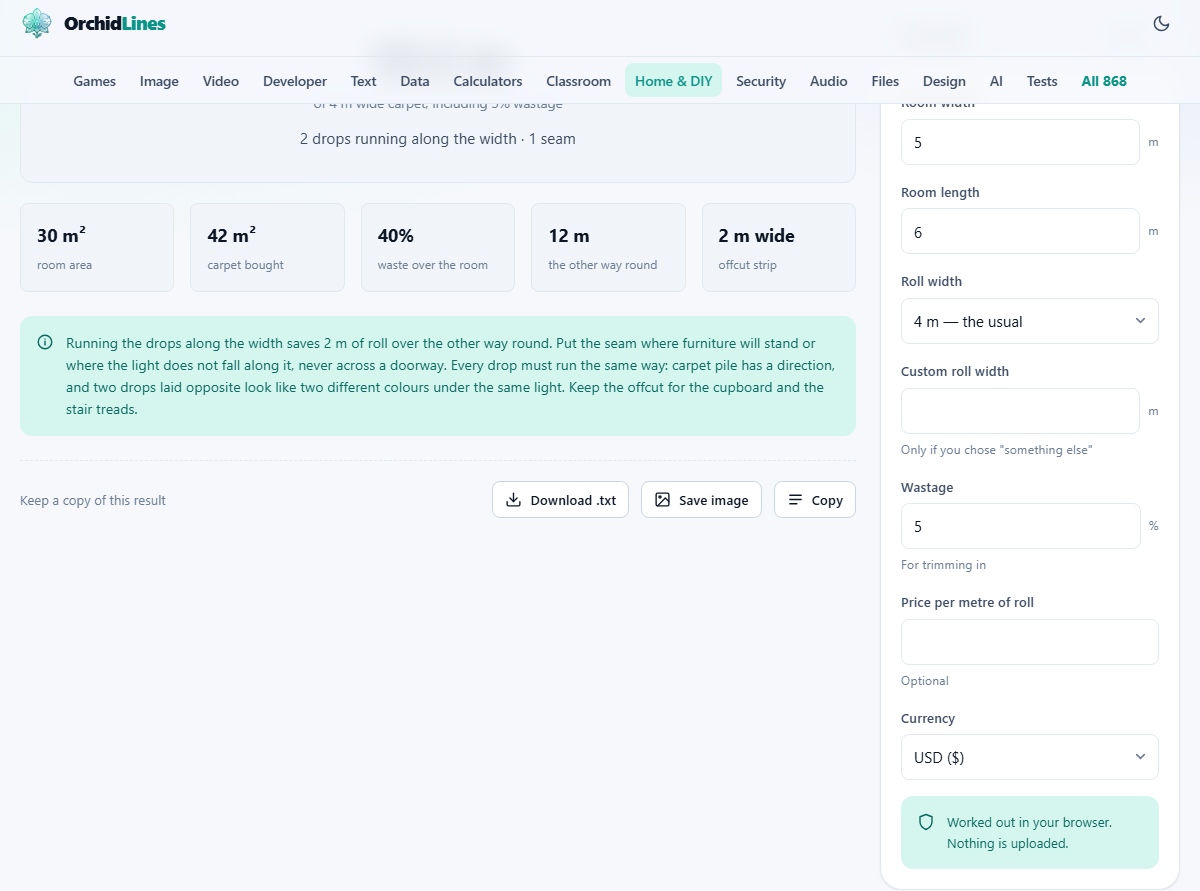
The problem with carpet
Carpet is not sold in rectangles that match your floor. It comes off a roll of fixed width, and you buy a length of that roll. Your room might be 5 metres by 6 metres, which is 30 square metres of floor. But you cannot buy exactly 30 square metres of carpet. You buy a number of metres off a roll that is typically 4 metres wide, and the total area you pay for is always more than the area of the room.
The tricky part is that the direction you lay the carpet changes how many metres of roll you need. Running the drops one way might take 10 metres. Running them the other way might take 12. Same room, same carpet, different bill. This calculator works out both directions and tells you which one wastes less.
Who should use it
Homeowners getting a quote from a carpet shop and wanting to check the figure. Carpet fitters sometimes quote for the more expensive direction because it puts the seam in a better spot, and sometimes they simply quote the first number they get. Knowing both lets you ask the right question.
Landlords refitting a property between tenants. Carpet is one of the bigger costs per room, and across six or eight rooms the saving from choosing the right direction in each one adds up quickly.
Contractors who measure rooms all day and want a fast second check. Typing two numbers in is quicker than sketching a drop plan on the back of a tape measure box.
Measuring the room
Two fields describe the room. Room width takes one dimension in metres. Room length takes the other. It does not matter which dimension goes in which field, because the calculator tries both directions anyway and compares the result.
Measure at the widest points, wall to wall, including any doorway recess you want carpeted. If the room has an alcove or a bay that sticks out, measure to the far edge of it. Carpet has to cover the whole floor, so the widest point is what counts even if most of the room is narrower. Do not subtract anything for skirting boards. The carpet tucks under them.
Setting the roll width
The dropdown labelled Roll width offers four standard sizes and a custom option. Four metres is the most common roll width in the UK and Europe and is selected by default. The 3.66 m option is a 12 foot roll, which is common in the US. Five metre rolls exist for very wide rooms and commercial jobs. Two metre rolls are used for narrow corridors and stairs.
If the carpet you want comes in a different width, pick Something else and type the actual width into the field labelled Custom roll width that appears below.
Getting this number wrong changes the entire answer. A room that fits in one drop on a 4 m roll might need two drops on a 3.66 m roll, which adds a seam and costs metres of extra carpet. Always check the roll width before you order.
Wastage and price
The field labelled Wastage starts at 5 per cent. That covers the trimming needed to fit the carpet neatly against the walls in a square room. If the walls are out of true, which they usually are in older houses, raise it to 10. An L shaped room or one with many alcoves might need more again, but for most rooms 5 to 10 is the right range.
Price per metre of roll is optional. If you enter a figure, the calculator multiplies it by the number of metres needed and shows the total cost. This is the price per running metre of the roll, not per square metre. Carpet shops sometimes quote per square metre, sometimes per running metre, and mixing them up doubles or halves the price in your head. Check which one the shop means before typing it in.
The Currency dropdown lets you pick the right symbol for the cost figure.
What the results show
The output compares two layouts. In one direction the drops run along the length of the room. In the other they run along the width. For each direction the calculator shows how many drops are needed, how many metres of roll that comes to, and how many seams will be on the floor.
The better direction is marked. It is usually the one that needs fewer metres, but sometimes it is also the one with fewer seams. A single drop with no seam at all is always the best result, because a seam is a visible line and a weak point in the carpet.
The offcut width is listed too. That is the strip left over when the last drop is cut from the roll. A fitter uses it for cupboards, landings and stairs, and it also serves as a repair piece if the carpet is damaged later. Knowing its width before you order tells you whether it will actually be useful or just a sliver.
Worked example with a living room
A room is 5 metres wide and 6 metres long. The roll is 4 metres wide. Wastage is set to 5 per cent.
Running the drops along the 6 metre dimension: each drop is 6 metres long. The room is 5 metres wide, and the roll is 4 metres, so one drop covers 4 metres of the width and a second drop covers the remaining 1 metre. That is 2 drops, each 6 metres long, making 12 metres of roll. One seam runs along the room 4 metres from one wall.
Running the drops along the 5 metre dimension: each drop is 5 metres long. The room is 6 metres wide. One drop covers 4 metres, a second covers the remaining 2 metres. Again 2 drops, but each is only 5 metres long, making 10 metres of roll. One seam, 4 metres from one wall.
The second direction needs 10 metres instead of 12. At a price of 25 pounds per metre, that is 250 instead of 300, a saving of 50 pounds on the same carpet for the same room. The 5 per cent wastage adds half a metre, bringing the order to 10.5 metres.
The offcut from the second layout is a strip 2 metres wide and 5 metres long. That is more than enough to carpet a hallway or a set of stairs.
Mistakes that cost money
- Buying by square metres when the shop sells by running metres, or the other way round. A 4 m wide roll at 25 pounds per running metre is 6.25 per square metre. Confusing the two is an easy way to double the bill.
- Laying two drops in opposite directions. Carpet pile has a nap. Two pieces laid against each other look like two different colours under the same light, and no amount of cleaning fixes it. Every drop must face the same way.
- Putting the seam across a doorway. That is the one spot on the floor that gets walked on most, and a seam there wears out first. Place it under furniture or where light does not run along it.
- Forgetting the doorway recess. If the carpet should run into the doorframe threshold, measure to that point, not to the wall. A carpet that stops 15 cm short of the door looks like a mistake.
- Throwing away the offcut. It is the only piece of matching carpet available for repairs later. Roll it up, label it with the room name, and store it.
When another calculator fits the job
- For carpet tiles sold by the box, there is no roll direction or drop calculation. A tile calculator works from the floor area alone.
- For vinyl or laminate flooring sold in planks, the waste pattern is different because planks can be staggered and cut.
- For underlay, which is sold in rolls of its own width, the same method applies but the roll width and price are different from the carpet. Run the calculator again with the underlay roll width.
- For measuring an irregular room with alcoves and bays, break it into rectangles and measure the largest one. The calculator handles one rectangle at a time.
Your measurements stay private
The entire calculation runs on your own device. No room sizes or prices are sent anywhere. There is no account needed, no data saved between visits, and nothing to delete. Close the tab and the figures are gone.