
Ordering the right number of bricks and the right amount of mortar
How the calculator counts bricks from a wall size and a bond pattern, what every input controls, a worked example for a garden wall, and the course table that stops you ending up halfway through a brick at the top.
What it works out
Building a wall means answering three questions before you order anything. How many bricks. How much mortar. And will the height you want land neatly on a joint or leave you cutting a row at the top.
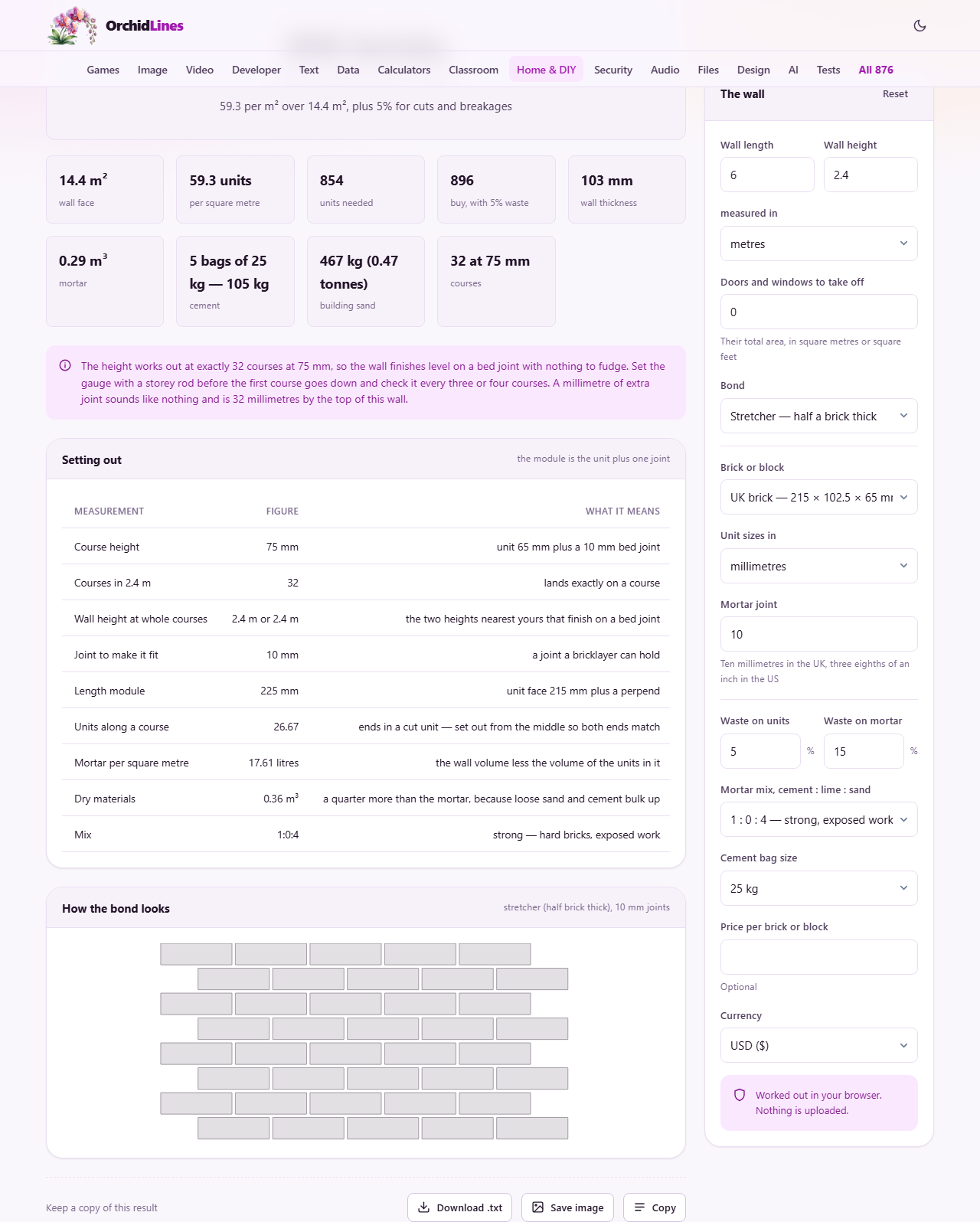
This calculator answers all three. Give it the wall dimensions, choose a bond pattern and a brick size, and it returns the number of bricks or blocks including waste, the mortar volume, the bags of cement, the weight of sand, and a course by course table showing exactly where every bed joint falls. It also draws eight courses of the bond pattern at true proportions so you can see what the wall will look like before you buy a single brick.
Who needs it
A homeowner building a garden wall for the first time. Ordering too few bricks means a second delivery from a different batch, and different batches never quite match in colour. Ordering too many means a stack of bricks sitting in the garden for years. Getting the count right saves both money and annoyance.
A contractor pricing a job. The materials cost is the biggest variable in a quote, and working it out by hand every time is slow. The calculator does the arithmetic in seconds and gives the mortar breakdown alongside the brick count.
Anyone planning a project and trying to decide between a half brick wall in stretcher bond and a full brick wall in English or Flemish bond. The calculator shows the count for each, so the difference in materials is clear before any commitment is made.
Describing the wall
Two fields at the top take the wall dimensions. Wall length is the total run in one direction. Wall height is from the foundation to the top. Both are entered in metres by default, but a dropdown labelled measured in lets you switch to feet.
Below that is Doors and windows to take off. Enter the total area of all openings in the wall, in square metres or square feet depending on what you chose above. A standard door is about 1.8 square metres. A small window is about 1.2. Add them up and put the total in. The calculator subtracts that area from the face of the wall before counting bricks.
Choosing the bond
The dropdown labelled Bond offers six patterns. Stretcher bond lays every brick with its long face showing and builds a wall half a brick thick, which is the standard single skin garden wall. Cavity wall means two stretcher bond skins separated by a gap, entered in the field labelled Cavity width that appears when you select it.
English bond alternates a whole course of long faces with a whole course of end faces and builds a wall one full brick thick. Flemish bond mixes long and end faces along every course but still builds one brick thick. Both use the same number of bricks. Header bond shows only the ends, and stack bond lays every brick directly above the one below with no overlap at all.
The drawing below the result shows eight courses of your chosen pattern at the real proportions of the brick you selected. Check it before ordering, because picking English when you meant Flemish doubles the confusion later.
Picking the brick or block
The dropdown labelled Brick or block holds a range of standard sizes. UK brick at 215 by 102.5 by 65 mm is the most common in Britain. Several UK block sizes are listed at 440 by 215 mm in 100, 140 and 215 mm thicknesses. American options include Modular, Queen, King and Utility bricks, plus 8 and 6 inch concrete masonry units. Aerated blocks at 600 by 200 mm in 100 and 200 mm widths round out the list.
If your brick is not on the list, choose Measure my own. Three fields appear for Length, Width and Height. A second dropdown labelled Unit sizes in lets you enter those in millimetres or inches. The tool uses those dimensions for every calculation from that point on.
The Mortar joint field sets the gap between bricks. Ten millimetres is the UK standard. Three eighths of an inch, which is about 9.5 mm, is the US standard. The course height is the brick height plus one joint, and everything else follows from that single number.
Waste and mortar settings
Two percentage fields sit side by side. Waste on units starts at 5 per cent, which covers breakages and the cuts on a straightforward wall. Raise it to 10 if the wall has many openings or angles that need more cutting. Waste on mortar starts at 15 per cent, because mortar falls off the trowel, sticks to the boards and gets scraped off the face. It is always higher than the brick waste.
The dropdown labelled Mortar mix, cement : lime : sand offers seven mixes from very strong to very lime rich. A 1:0:4 mix is the default and suits most exposed work. Below the damp course you want the stronger 1:0:3. Sheltered walls and older brickwork call for softer, lime rich mixes. The rule is that the mortar should always be softer than the brick. If it is harder, movement cracks the bricks instead of the joints, and that is far harder to repair.
Cement bag size covers the four common sizes: 25 kg, 50 kg, 50 lb and the American 94 lb sack. Price per brick or block and Currency are both optional and add a cost estimate to the output.
Worked example for a garden wall
A garden wall 6 metres long and 1.2 metres high with no openings, built in stretcher bond with standard UK bricks and 10 mm joints. Waste on bricks is 5 per cent and mortar waste is 15 per cent. The mix is 1:0:4.
The face area is 7.2 square metres. At 60 bricks per square metre in stretcher bond, the net count is 432. Adding 5 per cent waste brings the order to about 454 bricks.
Course height is 65 plus 10, which is 75 mm. That divides into 1200 mm exactly 16 times, so 1.2 metres is exactly 16 courses and the wall finishes neatly on a bed joint. If the wall had been 1.25 metres instead, the course table would show that 16 courses reach 1.2 and 17 courses reach 1.275, and it would tell you the joint thickness that would make 1.25 land exactly.
Mortar comes out at about 0.1 cubic metres. At the 1:0:4 mix that needs roughly 4 bags of 25 kg cement and about 250 kg of building sand. These are the numbers to take to the builders merchant.
Mistakes that cost time or money
- Ordering bricks in two deliveries. Bricks are fired in batches and no two batches match perfectly. A pallet from a later batch will show as a colour stripe across the wall for the life of the building. Order the whole job at once.
- Ignoring the course table. A height that does not land on a bed joint means either cutting the top course or adjusting every joint across the wall to spread the difference. Deciding before the first course goes down is the fix.
- Making the mortar stronger than the brick. A hard cement mix on a soft facing brick means cracks run through the bricks instead of the joints. Repointing a joint is a small repair. Replacing cracked bricks is a large one.
- Measuring the wall length along one side only. If the wall has a step or a return, add those lengths together. The calculator takes the total run.
- Forgetting mortar waste. Fifteen per cent sounds like a lot until you see how much ends up on the boards, the ground and the brickwork face. On a first project, twenty per cent is safer.
When a different tool is better suited
- For a patio or path laid flat rather than a wall built upright, a paving calculator handles the different geometry and waste patterns.
- For concrete foundations under the wall, a concrete volume calculator works out the trench fill.
- For retaining walls with reinforcement, the structural design goes beyond counting units and this calculator does not cover it.
- For rendering or plastering the finished wall, the material quantities are different from mortar joints and need their own calculation.
All the arithmetic stays on your device
Every figure is calculated right inside your browser. No measurements are sent anywhere. There is no account to create and no data stored after you close the tab. Type in a wall, read the answer, and take the list to the builders merchant.