
The number on the box is never the number in the tank
Why advertised tank volumes are always too high, how every field on the calculator changes the result, a worked example with a real four-foot tank, and the floor loading figure that decides where you can safely put it.
What the calculator works out
A fish tank sold as 240 litres is measured to the brim of the glass. Nobody fills a tank to the brim. The water sits below the rim, and substrate on the bottom pushes the water level up while taking away from the volume the fish can use. The real amount of water in a typical setup is around a fifth less than the number printed on the box.
This calculator takes the outside measurements of the tank, subtracts the glass thickness from each side, takes off the gap below the rim and the depth of substrate, and gives you the true water volume. It then uses that volume to work out the total weight on the floor, the heater wattage needed, and how many small fish the surface area can support.
Who needs these numbers
Anyone buying a new tank and wondering whether the upstairs bedroom floor can hold it. A filled four-foot tank weighs around 250 kilograms. That is three adults standing in one spot, and most domestic timber floors are not designed for that kind of concentrated load.
Fish keepers dosing treatments or fertilisers. Every bottle says a certain number of millilitres per litre of water. Using the box figure rather than the true water volume means you overdose by roughly twenty per cent every single time, and for medication that margin can stress or even kill the fish.
Hobbyists choosing a heater. A heater rated at one watt per litre keeps a tank at room temperature plus a few degrees. A colder room or a tropical species wanting 27 degrees needs more. The calculator gives a starting figure based on the real volume, not the inflated one.
The tank dimensions
Three fields describe the outside of the tank. Length is the long side as you look at the front. Front to back is the depth of the tank from front glass to back glass. Height is the distance from the base to the top rim. All three are entered in millimetres, which is the way aquarium manufacturers list their sizes.
A standard four-foot tank is roughly 1200 mm long, 400 mm front to back, and 500 mm high. These are the values the page starts with. If you have a different tank, measure the outside with a tape and type the numbers in. Do not subtract anything yourself - the calculator handles the glass and the gaps.
Freeboard, substrate and glass
Gap below the rim is the space between the water surface and the top edge of the glass. A typical figure is 25 to 30 millimetres. Some of that is to prevent splashing, and some is to leave room for the filter return and the heater cable. The default is 30.
Substrate depth is how deep the gravel or sand sits on the bottom. Fifty millimetres is a common planted tank depth. A bare bottom tank would be zero. The substrate takes away from the water volume and adds to the weight, so it matters in both directions.
Glass thickness affects the inside dimensions and the weight of the tank itself. Eight millimetres is the default, which suits most tanks up to about 1200 mm long. Larger tanks use 10 or 12 mm glass. If you are not sure, measure the edge at the top or check the manufacturer's sheet.
Fresh or marine
The dropdown labelled Water offers Freshwater and Marine / salt. The difference is density. Fresh water weighs one kilogram per litre. Salt water at a specific gravity of 1.025 weighs about two and a half per cent more. On a 200 litre tank that is an extra five kilograms, which is not dramatic on its own but adds up on a larger setup.
The stocking figure also changes. Marine fish generally need more space per fish than freshwater species, partly because of the higher oxygen demand and partly because territorial behaviour is more of a problem in a reef tank. If you are setting up a saltwater system, pick marine before reading the results, because the weight and stocking figures both shift.
What the results tell you
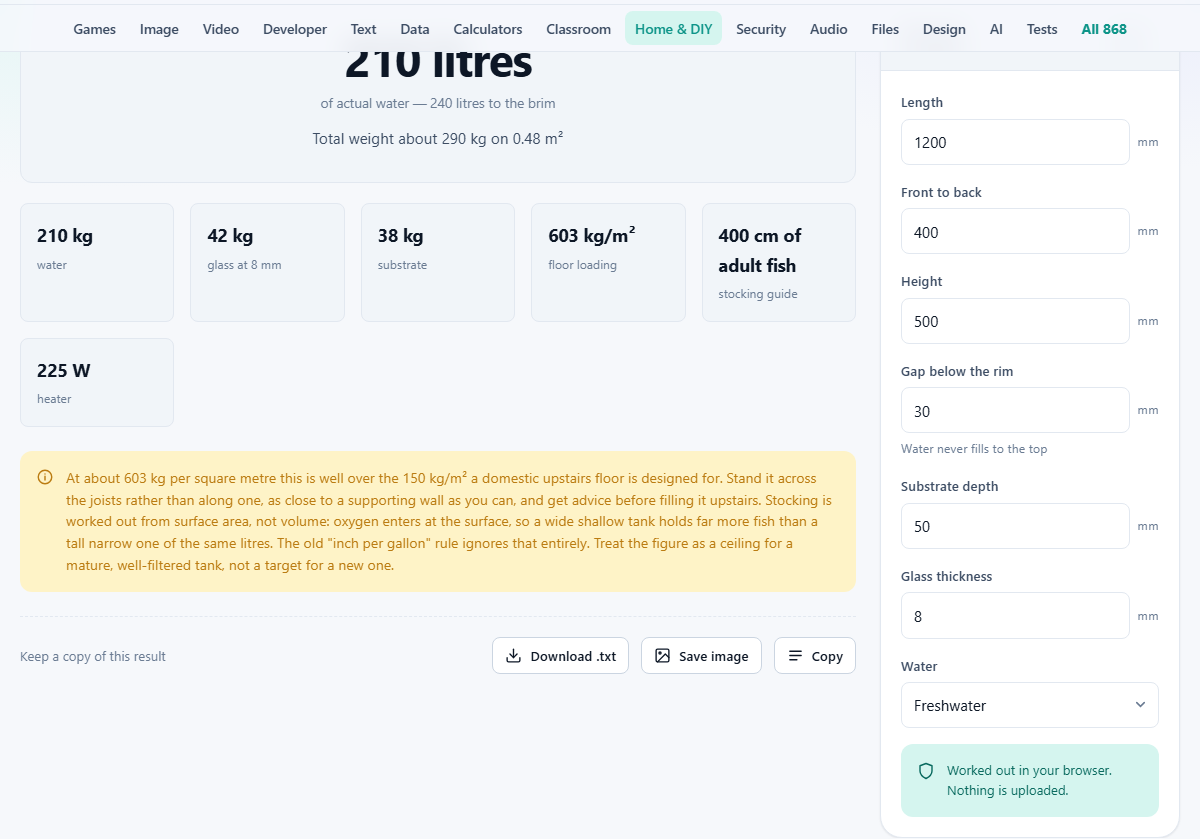
The output starts with the gross volume - the full inside space ignoring the water line and the substrate. Below that is the net volume, which is the actual water in the tank. The difference between the two is the number the box overstates by.
Total weight includes the water, the glass panels and the substrate. It is shown in kilograms. The floor loading figure takes that weight and divides it by the footprint of the tank to give kilograms per square metre. A domestic upstairs timber floor is typically rated for about 150 kilograms per square metre. If the tank exceeds that, the calculator warns you. Ground floor concrete slabs can handle far more, but upstairs on timber joists is where problems happen.
The heater figure is given in watts, based on roughly one watt per litre for raising the water a few degrees above room temperature. The stocking guide is measured in centimetres of small community fish, based on the surface area of the water rather than the volume. A wide shallow tank supports more fish than a tall narrow one of the same litres, because oxygen enters at the surface.
Worked example with a four-foot tank
A standard tank is 1200 mm long, 400 mm front to back, and 500 mm high. Glass is 8 mm. Gap below the rim is 30 mm. Substrate depth is 50 mm. Water is fresh.
The inside dimensions after subtracting the glass are 1184 mm by 384 mm. The usable height is 500 minus 8 for the base glass, minus 30 for the rim gap, minus 50 for the substrate, which leaves 412 mm of water depth. The gross volume is about 227 litres. The net water is about 187 litres, which is 40 litres less than the box would claim.
Total weight comes to around 260 kilograms once the glass and a gravel substrate are counted. The footprint is about 0.48 square metres, giving a floor loading of roughly 540 kilograms per square metre. That is well over the 150 figure for a timber floor, which is why four-foot tanks are best placed downstairs or directly over a load bearing wall.
The heater figure comes out at about 190 watts for a room kept at 20 degrees targeting 25. A 200 watt heater is the nearest standard size.
Common mistakes
- Putting a large tank upstairs without checking the floor. A two-foot nano tank is fine almost anywhere. Anything over 100 litres should be checked against the joist span and spacing, especially in an older house.
- Standing the tank along one joist instead of across several. Spreading the weight across three or four joists halves the load on each one. Close to a supporting wall is safest.
- Using the box volume for medication doses. Always dose on the net water figure. The overdose from using the advertised litres is enough to harm sensitive species.
- Filling the stocking number as a target rather than a ceiling. The figure assumes a mature, well filtered tank with regular water changes. A newly set up tank should be stocked gradually over several weeks.
- Forgetting that substrate weighs more than water. Gravel runs at about 1.5 kilograms per litre of volume it occupies. Fifty millimetres of gravel in a four-foot tank adds around 35 kilograms.
When a different tool is the right choice
- For a round or bowfront tank, this calculator assumes a rectangle. A bowfront or corner tank has a different footprint and holds less than the rectangle that contains it.
- For pond volume, which depends on irregular shape and depth, a pond calculator or a simple fill-and-measure test is more accurate.
- For the weight of a stand or cabinet, this gives the weight of the tank, water, glass and substrate. The stand itself is not included.
Everything stays on your own machine
The calculation runs entirely in your browser. No measurements are sent to any server and no data leaves your device at any point. There is no account, no stored data, and nothing to delete afterwards. Change a number and the results update on the spot. You could disconnect from the internet after loading the page and every calculation would still work, because there is nothing happening on the other end.