
Planning a letter banner that hangs well
Under the basic help sits this longer read: how to choose a flag shape and size for the room, what the two hanging systems change, how a wall measurement becomes a shopping figure for ribbon, and a start-to-finish example for a real celebration. It ends with rescue advice for the classic mistakes people make with paper flags.
The ribbon sum: flags, gaps, droop and two tails
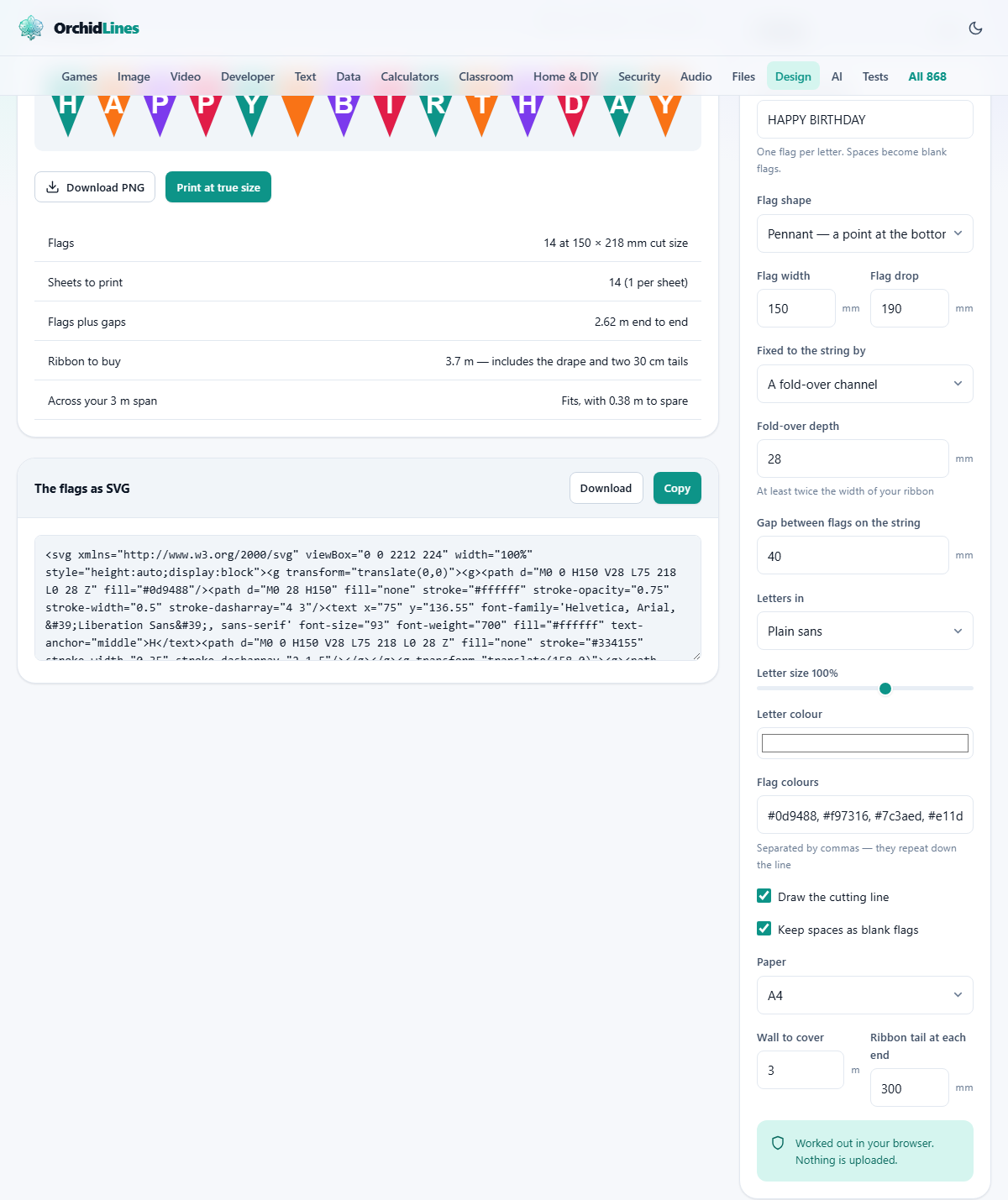
The ribbon figure comes from one short sum, done in millimetres. First the page measures the flat run. That is the flag count times the flag width, plus one gap for every space between two neighbours. Fourteen flags leave thirteen gaps, not fourteen. Then the run is multiplied by 1.17. Bunting is meant to sag, and a hanging string is longer than the straight line under it, so about a sixth is added on. Last, the tail you set is counted twice, once at each end. The answer is rounded up to the next 10 cm, because nobody buys ribbon by the millimetre.
Here is the set-up the page opens with, worked right through. The phrase is HAPPY BIRTHDAY. That is fourteen characters, and the space keeps a flag of its own, so fourteen flags. Each is 150 mm wide with a 40 mm gap. Flat run: 14 × 150 = 2100 mm of flag, plus 13 × 40 = 520 mm of gap, giving 2620 mm. The table shows that as 2.62 m end to end. Droop: 2620 × 1.17 = 3065.4 mm. Tails: two of 300 mm add 600 mm, for 3665.4 mm. Rounded up to whole tenths of a metre, the page tells you to buy 3.7 m.
The wall line is a separate test, and a blunter one. It sets the flat run against the span you typed, and looks at nothing else. With a 3 m wall and a 2.62 m run it reports 0.38 m to spare. The droop and the tails stay out of that check on purpose, since they hang below the line rather than along it. Type a wall shorter than the run and the page names the shortfall in metres, then suggests losing some phrase, some flag width or some gap.
- Flat run = flags × flag width + (flags − 1) × gap.
- Ribbon = flat run × 1.17, plus two tails, rounded up to the next 10 cm.
- 1.17 is the drape allowance, near enough one sixth extra for a gentle curve.
- A space becomes its own flag and counts in the run, unless blank flags are switched off.
- The phrase stops at 120 flags; anything after that is dropped without a word.
Cut size, letter height and how the flags land on paper
The fold-over is added above the flag, never carved out of it. Cut height is the fold-over depth plus the drop. On the opening settings that is 28 + 190 = 218 mm, which is why the table calls each flag 150 × 218 mm cut size. Every letter sits below the fold line, so nothing is lost when the top is turned over. Choose punched holes instead and that top strip is held between 10 and 20 mm, whatever number the depth box holds. The two holes are placed 16% and 84% of the way across, halfway down the strip. Each has a radius of a quarter of the strip depth, capped at 2.5 mm.
Letter height is taken from the flag, not from the letter. It starts as the smaller of 62% of the width and 55% of the drop, and your slider then scales that. On the opening settings 62% of 150 is 93, while 55% of 190 is 104.5, so 93 mm wins. Where the letter sits also follows the shape: 40% of the way down the drop on a pennant, 46% on a swallowtail, 45% on a scallop, and dead centre on a rectangle or a rounded flag. A pennant narrows as it falls, so a letter parked in the middle would crowd the point.
Sheet packing is plain division. Each sheet keeps a 5 mm margin all round and leaves 6 mm between neighbouring flags. The page tries the paper both ways up and keeps whichever holds more flags, with upright winning a draw. Upright A4 leaves 200 × 287 mm to work in. Across: (200 + 6) ÷ (150 + 6) = 1.32, so one column. Down: (287 + 6) ÷ (218 + 6) = 1.31, so one row. Laid sideways the same sheet gives 287 mm across and 200 mm down, which is one column and no full row at all. So the flags print upright, one to a sheet: fourteen flags, fourteen sheets. When a single flag will not fit any sheet, it is sliced instead, with a 10 mm overlap, a label on each piece and a faint line showing where the next sheet tucks under.
Print at full size or every number above is void. The page writes the chosen sheet size straight into the print rule and asks the printer for a zero margin, so 150 mm on screen is 150 mm on card. A shrink-to-fit or fit-to-page option quietly rescales the lot, and the flags come out a few millimetres small. That is enough to ruin a stack you meant to cut around a single master flag.
- The strip on screen always leaves 8 mm between flags, whatever the gap box says; the gap only feeds the ribbon sum.
- The downloaded SVG is that same strip, not the print layout.
- Nothing checks that a letter clears a sloping edge, so a wide W at 140% can cross the sides of a pennant.
- Card weight, ink and true sag are not modelled; the 1.17 is a rule of thumb, not physics.
- A blank flag still takes its turn in the colour list, so the colour order shifts after every space.
- Shown measurements are rounded to two decimal places, so cut from the printed flag, not from the caption.
The page thinks in flags, sheets and string
Type a phrase and every letter is given its own flag, drawn at the exact printed size and packed as many to a sheet as will fit. But the drawing is only half the job. The same settings feed a set of practical answers: how each flag fixes to its string, how far apart the flags sit, and how long the ribbon must be for the wall you have in mind.
That last part is the quiet star. Bunting fails at the ends, not in the middle: the string runs out one flag early, or nothing is left over to tie with. Because the page adds up the flags, the gaps, the natural droop and a tail for each end, the figure it reports is the one to take to the shop.
The phrase, the spaces, and the blanks
The box labelled What it should say drives everything. Each character becomes one flag, and a space in the phrase becomes an empty flag, so the break between words stays visible once the banner is up. The tick box Keep spaces as blank flags controls this. Left on, a two-word phrase keeps a coloured spacer between its words; switched off, the words run together with only the normal gap between them.
Blanks cost paper, so weigh the venue. Across a wide room, an empty flag makes each word readable from the far side. On a short run above a dessert table, dropping the blanks can save a couple of sheets of card and the phrase still reads perfectly well.
Shape, width and drop
Five outlines are on offer. The pennant tapers to a point and is the classic party look. The swallowtail cuts a notch instead, which reads festive and slightly nautical. The rectangle gives a letter the most room of any shape. The rounded bottom feels soft, right for a nursery wall, and the scalloped edge recalls old-fashioned fete decorations.
Flag width and flag drop each accept anything from 30 to 900 mm. Size to the reading distance: a hallway banner works small, a hall demands big. Larger flags also mean fewer per sheet, so the pile of printing grows with the party. Should a single letter ever outgrow the paper itself, its drawing is divided over more than one sheet, with a mark showing how far the pieces nest, so even giant letters stay printable at home.
Channel or holes
Fixed to the string by offers two systems. The fold-over channel bends the top of each flag over the ribbon and seals it down, so the string vanishes inside and the run looks continuous. The two punched holes let the ribbon lace through the face of each flag, or let you tie flags on one at a time, which makes fine spacing adjustments easy on the day itself.
Fold-over depth runs from 8 to 80 mm, and the field's own hint asks for at least double the ribbon's width. There is a reason: a snug channel pinches the ribbon, the flags refuse to slide, and the spacing can never be evened out once threaded. Gap between flags on the string, up to 400 mm, sets the breathing room between neighbours; something near a quarter of the flag width tends to look balanced.
Colour, letter style and contrast
Flag colours takes a list separated by commas, and the list repeats along the run, so two entries give alternating flags and four give a rotating sequence. Letter colour is one choice for the whole banner. The pairing that matters is contrast: pale letters on deep flags, or deep letters on pale ones. Middling tones against middling tones disappear at ten paces.
Letters in offers a plain sans, a serif and a rounded face. The Letter size slider runs from 40 to 140 per cent, scaling each character inside its flag. Wide letters such as M and W fill a flag more than a slim I does, so when a phrase leans on wide characters, pulling the slider down keeps everything clear of the edges. Draw the cutting line adds a printed outline for the scissors to follow; leave it off for a coloured edge with no border.
What you take home
The button marked Print at true size puts the sheets out at their actual dimensions, ready for cutting. The other exit is the SVG panel, where Download saves the whole drawing as one file and Copy places it on the clipboard for pasting into another program.
One honest caveat travels with that file. It stores the wording as live text, which keeps it tiny and lets you edit the phrase later, but it leaves the letter shapes to whatever machine opens it next. On a computer carrying different fonts, the words survive while the style drifts a little. When the look must match exactly, print from this page; when handing off to a print shop, open the file in a vector program first and turn the text into outlines.
Worked example: a christening banner
The brief: WELCOME ZARA above a fireplace 2.5 metres wide, in soft pinks and creams. Type the phrase, pick the rounded bottom shape, and set width 140 with a drop of 170, large enough to read across a lounge. In Flag colours, enter a pale pink and a cream so the flags alternate; make Letter colour a deep rose for contrast. The phrase holds eleven letters and one space, so twelve flags will print, the blank one keeping the two words apart.
The ribbon in the drawer is 10 mm wide, so a 28 mm fold-over gives it double clearance with room to slide. Set Wall to cover to 2.5 and leave the 300 mm ribbon tail at each end for tying off. Note the ribbon length the page works out, buy that much, then print on card, cut the flags, fold each top over the ribbon and fix it down. Slide the flags along until the word break sits centred over the mantelpiece.
Faster scissors, straighter strings
Cut the first flag slowly and treat it as the master: lay it on fresh card and cut around it so every later flag matches it exactly. Crease the fold line over a ruler edge before folding; card bends cleanly along a pressed line and lumpily without one. Glue and staples both close a channel, but stapling through the ribbon itself means the spacing is fixed forever.
Thread every flag before fixing anything. Hang the string loosely between its two points and step back: the droop changes how the phrase reads, and sliding flags along a hanging string is far easier than re-tying a finished banner. Only when it looks right from across the room should anything be fastened tight.
Jobs for a different tool
A one-piece banner, a single long strip carrying a painted message, is not a set of flags, and the site's design editor is the better home for it. Weather is the other boundary. These are paper flags: indoors they last for years in a keepsake box, but one shower finishes them. For a garden party, laminate each flag before threading, accept the shine, or plan around a single dry afternoon.
And if the goal is one enormous letter rather than a string of them, a simple poster print is easier to make and to mount than a flag with a channel it will never use.
Nothing leaves the room
The phrase, the colours and the wall measurement never leave your browser. The flags are drawn on your own device, and printing goes straight from it to the printer. There is no account behind the page, and no copy of your banner sits anywhere for a stranger to find, which matters when the banner carries a child's name.
The flip side is that the page cannot remember the design for you. If a banner might be wanted again, and birthdays do repeat, download the SVG, keep it with the party photos, and note the settings in the file name. Recreating the whole thing next year then takes a minute rather than an evening.